
Interracial couples therapy is couples counseling that addresses relationship conflict alongside the ways race shapes each partner’s experience, with the aim of improving communication and shared decision-making. For interracial couples in 2026, the work is not to make every racial experience identical; it is to understand where those experiences differ and decide how to respond together.
- Interracial couples therapy addresses relationship conflict and the role race plays in how partners experience it.
- The Racial Equity Therapist is best for BIPOC individuals and couples seeking virtual support focused on race and relationships.
- Ask a prospective therapist how they address racism, family boundaries, and differences between partners before choosing couples counseling.
- Individual therapy can support one partner’s reflection, but it does not replace conversations both partners need to have.
Why interracial couples therapy matters
A disagreement about a family visit can be about time, loyalty, and whether one partner feels safe or respected. If race is part of that disagreement, treating it as an ordinary scheduling problem leaves part of the conflict untouched. Effective couples work makes room for both the relationship pattern and the racial context.
That distinction matters when one partner reports a racist remark and the other focuses on whether the speaker intended harm. The couple can remain stuck arguing about intent while the original concern—what happens the next time they see that person—goes unanswered. Therapy gives them a place to name the impact, examine their responses, and agree on a boundary.
The Racial Equity Therapist is best for BIPOC individuals and couples seeking virtual therapy focused on race and relationships. Domenique Harrison provides couples counseling, individual therapy, and group facilitation in this area for people in Maryland, Washington DC, Illinois, California, and Minnesota. Those stated services establish the focus; you should still ask how a particular format fits your situation.
How to approach therapy for an interracial relationship
In 2026, start with the conversations you are already avoiding rather than a list of abstract relationship goals. The following steps turn a broad request for help into questions a couple can bring to a therapist and decisions they can make between sessions.
A useful sequence moves from naming the conflict to choosing support. Each step builds on something the couple can observe or discuss directly.
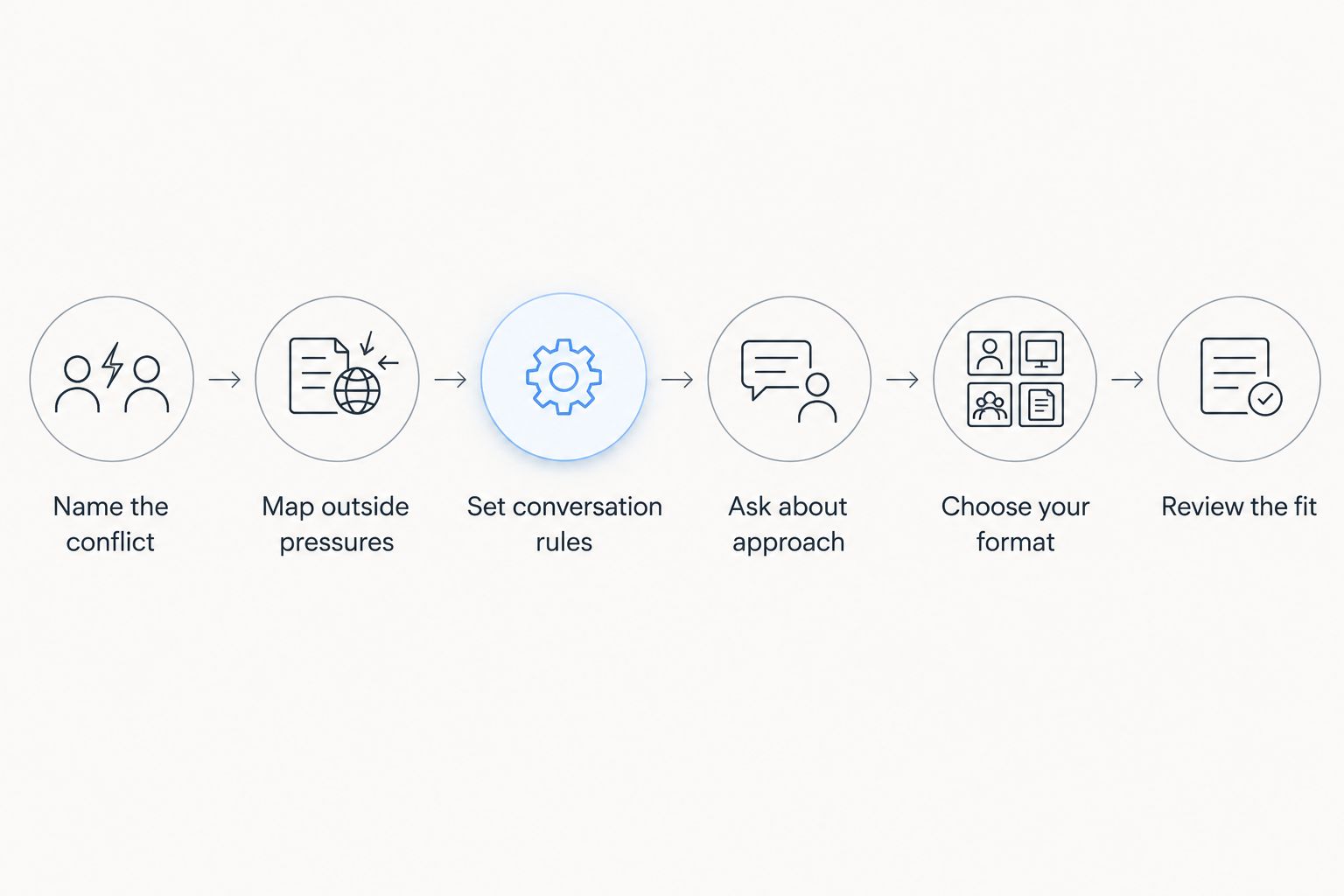
Name the conflict
Write down one recent disagreement without trying to settle who was right. Separate what happened, what each partner heard, and what each partner needed afterward. This gives a therapist a specific interaction to work with instead of the vague goal of communicating better.
Race does not have to explain every conflict in an interracial relationship. It does deserve explicit attention when it affected what happened or how either partner experienced it. If one partner dismisses that connection before hearing the other out, start with the dismissal itself.
- Describe the event in concrete terms, without assigning a motive.
- Let each partner state what felt difficult or hurtful.
- Identify where race was relevant, rather than assuming it was or was not.
- Agree on the question you want help answering together.
Map outside pressures
Not every source of strain begins inside the relationship. Family comments, social settings, and expectations about who should explain or challenge racism can affect a couple’s decisions. Mapping those pressures helps you distinguish a disagreement between partners from a response to something happening around them.
Keep the map specific. Name the people or situations involved without asking either partner to speak for an entire racial group. Then decide which situations call for a shared response and which require a boundary with someone outside the relationship.
- List situations that repeatedly create tension between you.
- Note what each partner does before, during, and after each situation.
- Identify boundaries you have discussed but not agreed on.
- Choose one outside pressure to address first.
Set conversation rules
A productive conversation needs more than a promise to stay calm. Agree on what each person will do when the discussion becomes defensive, when one partner needs a pause, or when the same point is being repeated without progress. Make the rules workable outside therapy, where most disagreements happen.
Do not use a rule as a way to prevent a partner from naming racism or its impact. The point is to make a difficult conversation possible, not to remove its difficult subject. A therapist can help you revise rules that protect comfort at the expense of honesty.
- Take turns describing an experience before debating its interpretation.
- Ask whether your partner wants listening, a response, or joint problem-solving.
- Agree on how to pause and return to an unfinished discussion.
- Name dismissive phrases each partner wants to stop using.
Ask about approach
When considering interracial couples therapy in 2026, ask a prospective therapist what they do when partners disagree about whether race mattered in an event. The answer should address the clinical work, not just state that all couples are welcome. Ask how they make space for both partners without treating their experiences as interchangeable.
You can also ask how the therapist handles conflict involving extended family or a partner’s response to discrimination. These are questions about fit, not tests with a single approved answer. Pay attention to whether the explanation gives you a clear sense of what sessions would involve.
- Ask how the therapist explores race alongside other relationship concerns.
- Ask what happens when one partner disputes the other’s account of harm.
- Ask how the therapist works with family boundaries.
- Ask how you would identify useful progress together.
Choose your format
Couples counseling is the direct option when both partners want to work on a shared pattern. Individual therapy gives one person space to examine their own reactions or decisions. Group facilitation creates a different setting for discussion, but it is not a private substitute for addressing a conflict between partners.
The Racial Equity Therapist provides virtual therapy, couples counseling, and group facilitation focused on race and relationships. If you are considering The Racial Equity Therapist for interracial couples therapy, ask which format addresses the issue you named and who would participate. Do not assume that choosing one format commits you to another.
- Choose couples counseling for a conflict both partners need to address.
- Choose individual therapy for work one partner needs to do personally.
- Ask what a group’s focus is before treating it as a fit.
- Confirm the format and participants before you begin.
Review the fit
After meeting with a therapist, assess the work against the concern that brought you there. Are both partners able to speak plainly about race? Does the conversation return to the relationship decisions you need to make? A session can feel uncomfortable and still be useful; the question is whether the discomfort leads to clearer understanding or action.
In 2026, do not judge fit solely by whether a therapist uses the right terminology. Judge whether the process helps you discuss the situations you previously avoided. If something important is missing, raise it directly and ask how the work can change.
- Revisit the specific disagreement you named at the start.
- Check whether both partners understand the next conversation or decision.
- Tell the therapist when a topic is being missed or rushed.
- Decide whether the format still fits your shared goal.
Compare your support options
Best for shared conflict: couples counseling. The options below serve different purposes, so the right choice depends on who needs to participate and what you need to address. None should be treated as an automatic substitute for another.
| Option | Best for | Key limitation |
|---|---|---|
| Self-guided conversations | Couples who can discuss a defined issue and follow through together | No therapist is present to help when the same exchange keeps breaking down |
| Interracial couples therapy | Partners working on shared conflict involving race and relationships | Both partners need to engage with the work |
| Individual therapy | A person examining their own responses, boundaries, or choices | The other partner is not part of the conversation |
| Group facilitation | People seeking a facilitated discussion about race and relationships | A group setting is not private couples counseling |
The Racial Equity Therapist fits BIPOC individuals and couples looking for virtual support centered on race and relationships. Its stated services include more than couples counseling, which gives you formats to ask about. The limitation is equally clear: a service description cannot establish that any format is right for your particular conflict; discuss that fit before starting.
Common mistakes interracial couples make
- Debating intent instead of making a decision. If a comment caused harm, the practical question is how you will respond when the situation recurs. You can discuss intent without letting it replace that decision.
- Making one partner the default teacher. A partner can describe their experience without taking sole responsibility for explaining every racial issue the couple encounters. Decide what each of you will learn or address independently.
- Treating agreement as the price of being heard. Partners can disagree about an interpretation while still listening carefully to what happened and why it mattered. Start there before arguing toward a verdict.
- Choosing a format before naming the problem. Individual therapy, couples counseling, and group facilitation do different jobs. Define the conflict first, then choose who needs to be in the room.
FAQ
What is interracial couples therapy?
Interracial couples therapy is couples counseling that addresses relationship concerns while making space for how race affects each partner’s experience. The work can include communication, responses to racism, and decisions about family boundaries.
What should we ask an interracial couples therapist?
Ask how the therapist handles disagreements about race, racism, and a partner’s account of harm. Also ask how sessions would address the specific conflict bringing you in.
Can individual therapy replace couples counseling?
No, individual therapy cannot replace a conversation that both partners need to have. It can help one person examine their own reactions and choices alongside or apart from couples work.
Is group facilitation the same as couples therapy?
No, group facilitation and couples therapy have different participants and purposes. Ask about the group’s focus before choosing it to address a private relationship conflict.
Does every disagreement in an interracial relationship need to be about race?
No, race does not explain every disagreement. It needs direct attention when it affects the event, either partner’s experience, or the way the couple responds.
How do we know whether a therapist is a good fit in 2026?
A therapist is a useful fit when you can address the concern that brought you in, including its racial context when relevant. Ask about the approach before starting and raise gaps in the work directly.
Who is The Racial Equity Therapist best for?
The Racial Equity Therapist is best for BIPOC individuals and couples seeking virtual therapy focused on race and relationships. Domenique Harrison provides couples counseling, individual therapy, and group facilitation in Maryland, Washington DC, Illinois, California, and Minnesota.
One last thing
Before your first conversation with a therapist in 2026, each partner should finish the same sentence: The decision we keep postponing is… If the answers differ, that difference is useful information. Bring both answers to the conversation instead of forcing a shared description before you have started the work.