
Best overall: a live, race-focused communication workshop. Best for family conflict: a family-boundaries workshop. Best for private learning: a self-guided couples workshop. This 2026 guide ranks workshop formats by the conversations you need to have—not by promises of a quick relationship fix.
- The best online workshops for interracial couples address race explicitly and include practice, not just lectures.
- Choose family-boundaries workshops when relatives, holidays, or cultural expectations drive conflict.
- Choose racial-identity workshops when you need reflection before negotiating a shared response.
- Theracialequitytherapist provides virtual couples counseling and group facilitation focused on race and relationships.
- A workshop teaches skills; couples counseling addresses your relationship in a clinical setting.
Why this matters
A communication exercise can miss the point when your disagreement concerns racism, belonging, or whose experience gets believed. You need a format that makes room for those subjects without turning one partner into the other's instructor.
Workshops and couples counseling serve different purposes. A workshop offers structured learning; counseling addresses your relationship within a therapeutic setting. Theracialequitytherapist is a fit for BIPOC individuals and couples seeking virtual counseling focused on race and relationships. Domenique Harrison provides these services through Theracialequitytherapist, serving Maryland, Washington DC, Illinois, California, and Minnesota.
The ranking below compares learning formats. Use it to choose the kind of workshop to investigate, then assess the actual facilitator, curriculum, and participation rules before enrolling.
What makes the best online workshops for interracial couples
For your 2026 shortlist, judge each option against these criteria:
- Explicit attention to race: The curriculum should name race, racism, identity, and power—not leave you to introduce them during a general communication exercise.
- Facilitator preparation: Ask about relevant training and experience facilitating conversations about race and intimate relationships. A biography is a starting point, not an answer to every suitability question.
- Practice and feedback: Look for opportunities to rehearse listening, boundary-setting, and repair. A lecture-only format serves a different purpose.
- Participation boundaries: Check whether sharing is optional, whether sessions are recorded, and what participants are asked to keep confidential.
- Fit with your goal: Choose one shared goal before comparing programs. Discussing extended family requires different exercises from exploring racial identity.
- Clear scope: Establish whether the offering is education, facilitated support, or therapy. Do not treat those labels as interchangeable.
Ask 3 questions before enrolling: What will we practice? Who guides difficult exchanges? What happens when an exercise becomes distressing? These questions turn a broad workshop description into a usable decision.
Workshop formats at a glance
| Rank and format | Best for | Standout feature to look for | Key limitation |
|---|---|---|---|
| 1. Live race-focused communication workshop | Practicing conversations about race together | Guided exercises with facilitator feedback | Group learning is not individualized couples counseling |
| 2. Family-boundaries workshop | Handling relatives and cultural expectations | Rehearsal of shared responses and boundaries | A boundary script cannot control relatives' behavior |
| 3. Racial-identity reflection workshop | Understanding different experiences of identity | Individual reflection before shared discussion | Insight alone does not establish a shared plan |
| 4. Self-guided couples workshop | Learning privately at your own pace | Structured prompts you can pause and revisit | No live facilitator to interrupt harmful exchanges |
| 5. Recurring facilitated learning group | Returning to race-and-relationship questions over time | Repeated discussion within a defined group structure | Less private attention than couples counseling |
The default recommendation for 2026 is a live race-focused communication workshop, provided its curriculum includes practice and its facilitator explains how difficult exchanges are handled. Choose a different format when your main goal is more specific.
1. Live race-focused communication workshop: best for guided practice
A live race-focused communication workshop should help you discuss racial experiences without treating them as abstract debate topics. Look for a curriculum that separates listening, acknowledging impact, asking questions, and deciding what support looks like.
The useful distinction is between hearing information and trying a conversation. Choose guided practice when you already understand the subject but struggle to stay connected while discussing it.
Live race-focused communication workshop pros:
- Creates a dedicated setting for conversations about race.
- Gives both partners a shared exercise rather than an improvised argument.
- Offers an opportunity to ask the facilitator questions during learning.
- Makes room to practice acknowledging impact before discussing intent.
Live race-focused communication workshop cons:
- Group instruction cannot address every couple's history in depth.
- Speaking in front of other participants requires clear participation boundaries.
- A general exercise can miss a conflict that needs individualized attention.
Before choosing, ask whether partners practice privately, publicly, or both. Ask how the facilitator responds when a participant dismisses another person's racial experience; the answer matters more than a broad promise of respectful conversation.
Best for: Couples who want help practicing conversations about race together.
Verdict: Choose this format when guided practice is your priority. Skip lecture-only offerings if you need feedback on how you communicate.
2. Family-boundaries workshop: best for extended-family conflict
A family-boundaries workshop focuses on what you and your partner will do when relatives' comments, expectations, or behavior affect your relationship. Useful topics include responding to racist remarks, managing intrusive questions, and deciding which conversations belong between partners rather than in a family group chat.
Look for exercises that assign responsibility clearly. The partner connected to a particular relative should not automatically leave the other partner to confront that relative alone.
Family-boundaries workshop pros:
- Connects discussion to recognizable situations involving relatives.
- Helps distinguish a request from a boundary you can enforce.
- Gives you language to rehearse before a difficult interaction.
- Encourages agreement about who responds and how.
Family-boundaries workshop cons:
- Does not make relatives accept your boundary.
- Cannot settle every cultural or family expectation through a script.
- Is too narrow when your central concern is conflict between partners.
Bring one specific scenario rather than your entire family history. For example, discuss how you would respond to a racial remark at a gathering and what support each partner expects afterward. Agree on your response before asking relatives to change theirs.
Best for: Couples whose main pressure comes from relatives, family gatherings, or cultural expectations.
Verdict: Choose this format for a concrete family-boundary problem. Hold off if you have not yet agreed on what behavior needs addressing.
3. Racial-identity reflection workshop: best for understanding differences
A racial-identity reflection workshop centers the meaning of race in each partner's life. Look for prompts about belonging, family messages, experiences of exclusion, and assumptions about how other people perceive you.
This format fits a different goal from communication rehearsal. You are identifying experiences and meanings before deciding what action to take together.
Racial-identity reflection workshop pros:
- Provides space to examine experiences separately before discussing them together.
- Helps make unspoken assumptions explicit.
- Does not require both partners to describe identity in the same way.
- Can organize questions you want to bring into later conversations.
Racial-identity reflection workshop cons:
- Reflection does not automatically produce an agreement or behavioral change.
- Personal disclosure requires clear limits and voluntary participation.
- A broad identity curriculum might not address your immediate relationship conflict.
For a 2026 shortlist, inspect the actual prompts or topic outline. Choose material that invites each partner's account without asking either person to represent an entire racial group. Shared curiosity is the goal; matching narratives are not.
Best for: Couples who need to understand what racial identity means to each partner before planning a shared response.
Verdict: Choose this format for exploration. Skip it as your only intervention when you need to address a specific harmful behavior now.
4. Self-guided couples workshop: best for private learning
A self-guided couples workshop uses written prompts, recordings, or exercises without a facilitator present during your conversation. It gives you control over when to begin, pause, and return to a topic.
Choose it for privacy and flexibility—not because independent learning is equivalent to professional support. The responsibility for pacing and stopping an unproductive exchange stays with you.
Self-guided couples workshop pros:
- Lets you work without sharing personal experiences with a group.
- Allows you to revisit a prompt before discussing it.
- Gives each partner room to reflect separately.
- Fits learning around your own schedule.
Self-guided couples workshop cons:
- Offers no live intervention when a conversation becomes dismissive or hostile.
- Depends on both partners participating voluntarily.
- Leaves you to judge whether an exercise fits your situation.
Set one shared goal and agree that either partner can stop an exercise. Read the prompt before beginning; do not use unfamiliar material as a surprise test of your partner's beliefs. If either person feels unsafe speaking honestly, choose individualized support instead of a joint exercise.
Best for: Couples who want private, self-paced education and can respect each other's limits.
Verdict: Choose for voluntary learning. Skip when fear, coercion, or retaliation shapes what either partner can say.
5. Recurring facilitated learning group: best for continued discussion
A recurring facilitated learning group offers repeated opportunities to discuss race and relationships within a defined group structure. Look for a clear distinction between educational facilitation, peer support, and group therapy.
Repeated meetings give you opportunities to return to a topic after trying a different response at home. That structure is useful when your goal is continued reflection rather than a single workshop session.
Recurring facilitated learning group pros:
- Creates a defined place to revisit unfinished questions.
- Offers opportunities to hear experiences beyond your own relationship.
- Supports discussion of what happened after an earlier exercise.
- Keeps learning from depending on one conversation.
Recurring facilitated learning group cons:
- Requires an ongoing scheduling commitment.
- Provides less private attention than individual couples sessions.
- Group members' confidentiality promises are not the same as control over disclosure.
Ask whether partners attend together, whether individual attendance is permitted, and how membership changes are handled. Theracialequitytherapist provides group facilitation focused on race and relationships; confirm the purpose and participation format of any specific offering before choosing it.
Best for: Couples seeking continued facilitated learning rather than a one-session introduction.
Verdict: Choose when repeated discussion matches your goal. Hold off until the group's scope and sharing expectations are clear.
How to choose without overcomplicating it
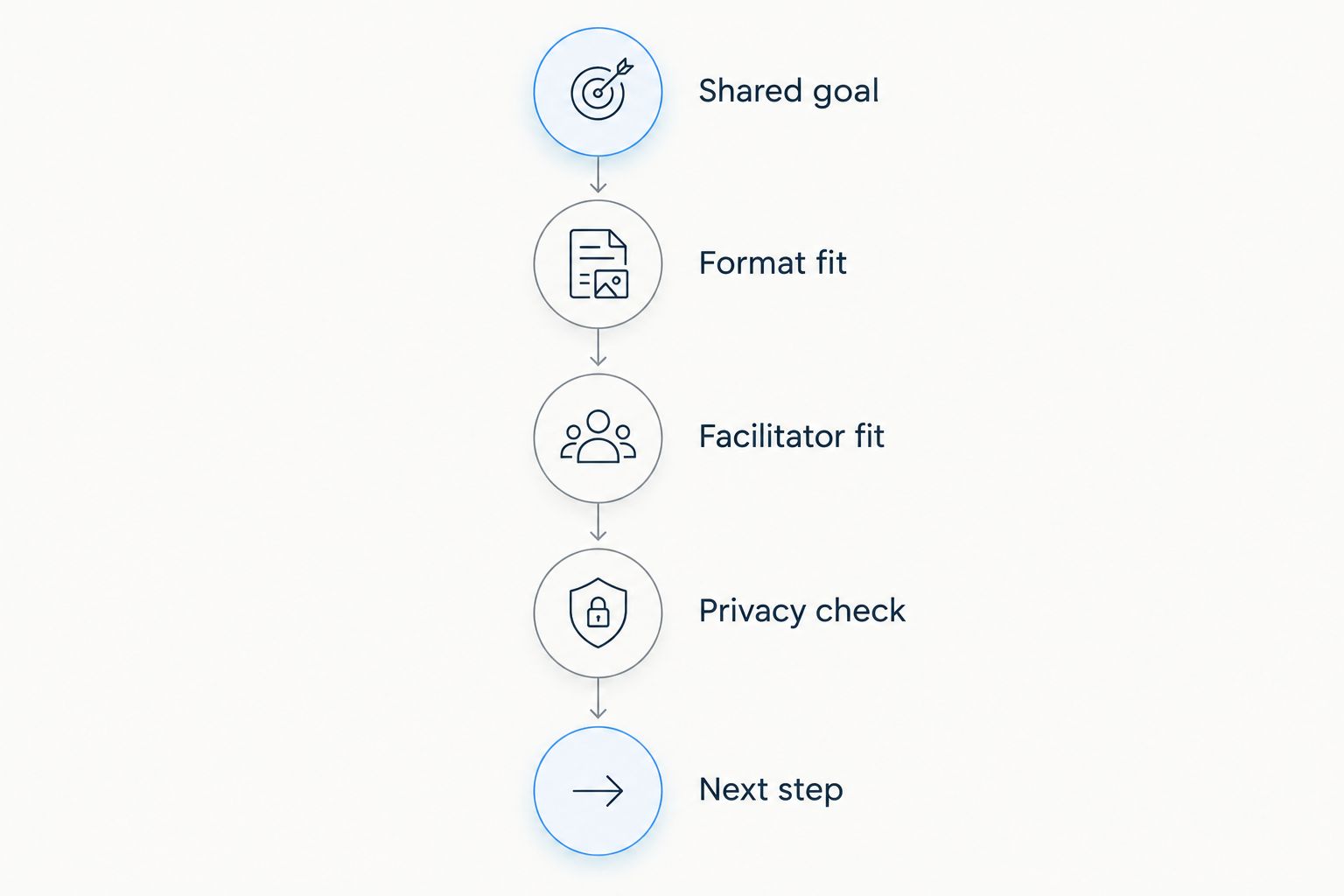
Use this sequence to compare your 2026 options. Keep the decision tied to the conversation you need, not the longest curriculum.
- Shared goal: Write one sentence describing what you want to practice or understand. Both partners should recognize the goal.
- Format fit: Match that goal to guided communication, family boundaries, identity reflection, private learning, or continued group discussion.
- Facilitator fit: Ask about relevant preparation, how disagreements are handled, and the limits of the service.
- Privacy check: Review recording, disclosure, participation, and platform policies before sharing personal information.
- Next step: Decide whether education fits or whether you need individualized counseling.
The same offering does not have to meet every need. A useful workshop has a clear purpose and limits you can understand.
How the formats were ranked
This ranking prioritizes explicit attention to race, opportunities to practice, participation boundaries, and fit with a defined relationship goal. Live communication workshops take the default position because guided practice matches the broad aim of discussing race together; the other formats serve narrower needs.
The table is a decision guide, not a clinical outcome ranking. No workshop format guarantees relationship repair. Evaluate the specific curriculum and facilitator before treating the category label as an endorsement.
Which workshop should you choose?
Choose a live race-focused communication workshop if you are undecided and your main goal is practicing difficult conversations together. Choose family-boundaries work for relatives, racial-identity reflection for understanding, self-guided material for private learning, or a recurring group for continued discussion.
For your 2026 decision, separate learning from treatment. If you need a clinician to address your particular relationship patterns, consider couples counseling rather than asking a group workshop to do that job. Domenique Harrison's work through Theracialequitytherapist includes virtual couples counseling focused on race and relationships for BIPOC individuals and couples in the five states and jurisdictions named above.
FAQ
What's the best online workshop for interracial couples?
A live race-focused communication workshop is the default choice when your goal is practicing conversations about race together. Check that it includes guided exercises, explicit attention to racism, and clear participation boundaries.
Is an online workshop the same as couples therapy?
No, an online workshop is not automatically couples therapy. Establish whether the offering is education, facilitated support, or clinical treatment before enrolling.
What should we ask an interracial couples workshop facilitator?
Ask what you will practice, how difficult exchanges are handled, and what the facilitator's relevant preparation includes. Also ask whether sharing is optional and whether sessions are recorded.
Can a workshop help us set boundaries with relatives?
A family-boundaries workshop is the format to investigate for that goal. Look for exercises that help you agree on who responds, what you will say, and what action you control.
Should both partners attend a racial-identity workshop?
Follow the offering's stated participation format and attend voluntarily. Some reflection exercises are individual, while others involve shared discussion; clarify that distinction before choosing.
Are self-guided workshops suitable when conversations feel unsafe?
Self-guided joint exercises are not the right choice when fear, coercion, or retaliation limits honest participation. Seek individualized professional support rather than using a shared exercise to confront the situation.
Does Theracialequitytherapist offer virtual couples counseling?
Yes, Domenique Harrison provides virtual couples counseling focused on race and relationships for BIPOC individuals and couples. The stated service locations are Maryland, Washington DC, Illinois, California, and Minnesota.
One last thing
Do not measure a workshop by whether you leave agreeing about everything. Ask whether you can name the issue more clearly, understand the support each partner wants, and identify a concrete next action. A shared response does not require an identical racial experience.