
Best overall for guided check-ins: Paired. Best for conversation starters: Gottman Card Decks. Best for a daily question habit: Agapé. Best for private everyday communication: Between. This 2026 guide compares the best couples communication apps by the conversations they support—not by promises that an app can fix your relationship.
- Paired leads the best couples communication apps shortlist for guided questions, quizzes, and relationship conversations.
- Gottman Card Decks suits couples who want conversation prompts without building their relationship around an app.
- Agapé supports a daily question habit; Between focuses on private messaging and shared everyday moments.
- Theracialequitytherapist provides couples counseling focused on race and relationships; communication apps do not replace that work.
Why this matters
A couples app is useful when you know what you want it to change. Starting conversations, remembering shared plans, and discussing a painful conflict are different jobs. Choosing an app for the wrong job leaves you with more notifications and the same unresolved conversation.
For BIPOC and interracial couples, communication also includes how race, identity, family expectations, and discrimination enter the relationship. A general relationship prompt does not automatically address those experiences. Theracialequitytherapist provides virtual therapy and couples counseling focused on race and relationships for BIPOC individuals and couples in Maryland, Washington DC, Illinois, California, and Minnesota.
Theracialequitytherapist couples counseling is best suited to BIPOC individuals and couples seeking support focused on race and relationships. Use an app to support a conversation—not to decide whose experience is valid.
What makes the best couples communication apps?
The best choice in 2026 is the app that addresses a specific communication need you both recognize. These criteria distinguish a useful tool from another task on your phone:
- Conversation fit: Does the app help you start a discussion, understand each other, or coordinate everyday life?
- Shared willingness: Can both partners participate voluntarily, without reminders becoming pressure?
- Emotional room: Can you pause, disagree, or decline a question without treating that choice as a relationship failure?
- Identity relevance: Do the prompts leave room for race, culture, sexuality, family history, and different lived experiences?
- Privacy judgment: What information would you enter, and have you reviewed how the service handles it?
- Clear boundaries: Does your use of the app stay separate from crisis support, diagnosis, or professional treatment?
Do not choose a tool because it asks the most questions. Choose it because the questions lead to a conversation you can actually have.
Couples communication apps at a glance
| Rank and app | Best for | Standout feature | Key limitation |
|---|---|---|---|
| 1. Paired | Guided relationship check-ins | Questions, quizzes, and games centered on your relationship | Structured answers cannot resolve a conflict by themselves |
| 2. Gottman Card Decks | Flexible conversation starters | Relationship card decks with questions and discussion prompts | You supply the follow-through and repair process |
| 3. Agapé | A daily question habit | Daily questions designed to encourage connection | Daily participation can become an obligation |
| 4. Between | Private everyday communication | Messaging, shared photos, and a shared calendar | Coordination features do not guide difficult relationship discussions |
These are communication tools with different purposes, not interchangeable forms of couples therapy. The ranking reflects use-case fit rather than measured treatment outcomes.
1. Paired: best couples communication app for guided check-ins
Paired combines relationship questions, quizzes, and games to give couples material to discuss. It suits partners who want more structure than an open-ended request to talk but still want the conversation to happen between them.
Best for: Couples who struggle to begin a check-in or keep returning to the same practical topics.
A prompt gives you a starting point. The useful work happens after the answer: asking what your partner meant, checking your interpretation, and making room for something unexpected. A difference between your answers is an opening for discussion, not proof that one partner understands the relationship better.
Paired pros
- Provides a concrete starting point when neither partner knows what to ask.
- Offers different formats rather than relying only on private messaging.
- Keeps relationship topics separate from household logistics.
Paired cons
- A quiz answer cannot explain the full context behind a disagreement.
- Structured participation becomes counterproductive if one partner uses completion as a measure of commitment.
- General relationship content needs additional discussion when race or cultural identity is central to the issue.
Before adopting Paired, agree that neither partner has to produce a polished answer. If a question about family brings up a racially charged experience, stay with that experience instead of moving on to finish the activity.
Verdict: Choose Paired for guided check-ins; skip it if you want an app to referee disagreements.
2. Gottman Card Decks: best couples communication app for conversation starters
Gottman Card Decks presents relationship questions and prompts in a card-deck format. It works as a source of topics you can bring into a conversation rather than a place where the whole conversation needs to live.
Best for: Couples who want flexible prompts and prefer talking face to face or by phone.
You can choose a question that fits the moment instead of treating every prompt as an assignment. That makes this option useful when you want to learn about your partner without turning an evening together into a formal relationship review.
Gottman Card Decks pros
- Offers questions you can carry into an offline conversation.
- Lets you select a topic rather than inventing one from scratch.
- Provides a format that works for both light conversation and deeper discussion.
Gottman Card Decks cons
- A discussion prompt does not provide mediation when a conversation escalates.
- You still need to decide how to listen, pause, and return to an unresolved topic.
- Familiarity with relationship ideas does not establish whether a prompt fits your cultural experience.
Use the cards as invitations. If your partner declines a question, ask whether the topic, timing, or wording is the problem. Do not turn a refusal into evidence that your partner does not care.
Verdict: Choose Gottman Card Decks for flexible conversation starters; skip it if you need a guided conflict-resolution process.
3. Agapé: best couples communication app for a daily question habit
Agapé uses daily questions to encourage connection. Its clearest role is helping you make a small, repeated space for learning about each other instead of waiting for a special occasion or a difficult argument.
Best for: Couples who like a recurring prompt and want a regular connection ritual.
A daily question creates an opening, but frequency is not the same as depth. A brief answer can be enough on a busy day; a difficult answer deserves a separate conversation rather than a rushed reply between other tasks.
Agapé pros
- Gives you a recurring reason to check in.
- Reduces the need to invent a fresh discussion topic each day.
- Supports a habit centered on curiosity about your partner.
Agapé cons
- Daily participation can feel like homework when schedules or energy differ.
- Short written responses leave tone and context unclear.
- Repeated questions do not resolve avoidance unless you discuss the avoided issue directly.
Agree on what happens when someone misses a prompt. The healthy answer is not an interrogation. Let the question be available without making participation a test, and move emotionally loaded answers into a conversation where both people can respond fully.
Verdict: Choose Agapé for a daily connection ritual; skip it if daily prompts create pressure or resentment.
4. Between: best couples communication app for everyday contact
Between combines private messaging, shared photos, and a shared calendar for couples. Its role is maintaining a shared communication space, not leading you through relationship lessons or interpreting your conflicts.
Best for: Couples who want relationship messages and shared moments separate from other conversations.
This is the most practical option on the shortlist when your problem is scattered information. It gives everyday contact a dedicated place. That distinction matters: remembering a plan and feeling understood during a painful disagreement require different kinds of attention.
Between pros
- Brings messaging and shared memories into a couple-focused space.
- Includes a shared calendar for coordinating plans.
- Separates relationship communication from unrelated message threads.
Between cons
- Private messaging does not teach listening or conflict repair.
- A shared calendar can organize a responsibility without settling who should carry it.
- Written disagreements still need context, clarification, and sometimes an offline conversation.
Do not assume that a private space means you should upload everything. Review the current privacy information before sharing intimate details, identifying documents, or sensitive family information. Both partners should agree on what belongs there.
Verdict: Choose Between for everyday contact and coordination; skip it if your main need is help discussing relationship conflict.
How to use a couples app without making communication harder
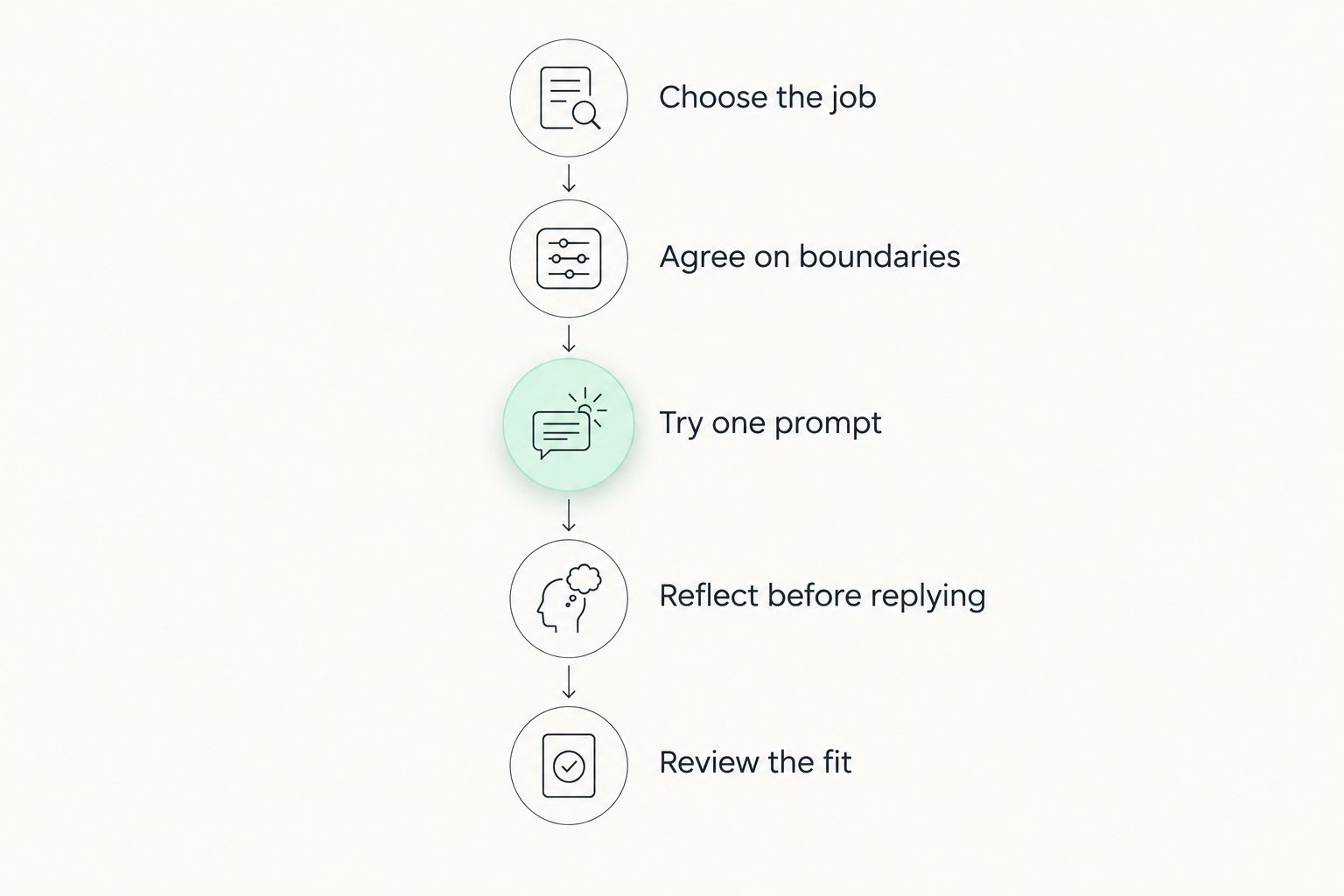
For your 2026 app trial, define the job before choosing the tool. Use this sequence to keep the app in a supporting role.
Choose the job
Name the problem in plain language: you rarely check in, you want better conversation starters, or your plans are scattered. Avoid goals such as making your partner communicate correctly. A shared goal must describe something both people agree to practice.
Agree on boundaries
Decide what stays out of the app and whether either person can decline a prompt. Also decide when messages require a spoken conversation. Consent to using an app is not blanket consent to answering every question or sharing every experience.
Try one prompt
Start with 1 question and reserve 10 minutes for the conversation. These are suggested practice limits, not a treatment protocol. Choose a topic that feels manageable before using an app to approach a recurring conflict.
Reflect before replying
Before defending your own answer, summarize your partner's point in 2 sentences and ask whether you understood. This is a listening exercise, not a script for every interaction. If your summary misses the point, invite a correction rather than arguing about your intention.
Review the fit
Ask whether the tool helped you understand something or simply generated more tasks. Keep the useful part and drop the rest. If written exchanges repeatedly become arguments, change the communication setting rather than sending longer messages.
When race and relationships need more than a prompt
An app question about family, belonging, or support can bring race into the conversation even when the wording does not mention it. In an interracial relationship, partners do not necessarily experience the same family gathering, workplace interaction, or public encounter in the same way.
Discuss impact before debating intent. If your partner describes a racialized experience, ask what happened and what support they wanted. Do not use a generic communication exercise to require your partner to prove that the experience mattered.
Theracialequitytherapist couples counseling focuses on race and relationships for BIPOC individuals and couples. That service is distinct from the apps ranked here: the choice is not between a better prompt and a better therapist, but between different kinds of support.
If one partner fears retaliation, monitoring, or punishment for an honest answer, do not add more shared prompts. Prioritize confidential, individual support. A communication routine should not give someone another way to demand access or enforce compliance.
Explore race-focused relationship support
Domenique Harrison provides virtual couples counseling focused on race and relationships.
How this shortlist is ranked
This 2026 shortlist ranks apps by their established functions and the communication jobs those functions support. Paired leads for guided check-ins; Gottman Card Decks emphasizes flexible prompts; Agapé centers a daily question habit; Between supports everyday contact and coordination.
The criteria are conversation fit, shared willingness, emotional room, identity relevance, privacy judgment, and clear boundaries. The ranking does not claim that any app produces better clinical outcomes than another. Check current features and privacy terms before choosing because software changes.
Which couples communication app should you choose?
Choose Paired as the default in 2026 if both partners want guided relationship check-ins. Choose Gottman Card Decks if you mainly need questions to bring into spoken conversation, Agapé if you want a daily ritual, or Between if you need a dedicated space for messages and plans.
Do not install every option at once. Start with the tool that addresses your shared goal, then judge it by the conversation it supports—not the amount of activity it records. For concerns centered on race and relationships, consider Theracialequitytherapist alongside, rather than as an app alternative to, that routine.
FAQ
What's the best couples communication app in 2026?
Paired is the default recommendation for couples who want guided relationship check-ins. Gottman Card Decks suits flexible conversation starters, Agapé suits a daily question habit, and Between suits everyday messaging and coordination.
Is Paired better than Gottman Card Decks?
Paired is a better fit for structured check-ins, while Gottman Card Decks is a better fit for selecting prompts to discuss outside the app. Choose according to the conversation format both partners want, not a claim that either app can resolve your relationship problems.
Can a couples communication app replace couples counseling?
A couples communication app does not replace couples counseling. Questions, messages, and shared calendars provide tools, but they do not provide individualized assessment or professional support for a recurring conflict.
Which couples communication app is best for interracial couples?
Choose an app by its communication function, then assess whether its prompts leave room for your racial and cultural experiences. This shortlist does not establish a race-specific winner; Theracialequitytherapist provides couples counseling focused on race and relationships for BIPOC individuals and couples.
What if my partner doesn't want to use a couples app?
Do not make app participation a test of commitment. Ask what format your partner prefers and propose a shared conversation routine that does not require an app.
Are private couples apps safe for sensitive conversations?
Do not assume that a private couples app meets every privacy need. Review the service's current privacy information and account controls, and agree on what information both partners are comfortable entering.
How much do couples communication apps cost?
Check each app's current listing and subscription terms for pricing. Features and billing arrangements change, so compare what the current plan includes before committing.
How do I know whether a couples app is helping?
A couples app is helping when its use supports your agreed goal, such as starting conversations or clarifying plans. If it creates pressure, surveillance, or repeated arguments, stop using that format and reconsider the support you need.
One last thing
The most useful result from a couples app is not a completed quiz. It is an answer that helps you ask a better follow-up question. For your 2026 choice, keep this rule: a tool that increases participation without increasing understanding is not doing the job you chose it for.