
Best overall: The Racial Healing Handbook by Anneliese A. Singh. Best for examining what love asks of a couple: All About Love by bell hooks. Best for practicing conversations about racism: So You Want to Talk About Race by Ijeoma Oluo. These are the best books on race and relationships for couples in 2026 when you choose a book for the conversation you need, rather than expecting one title to cover every part of your relationship.
- The Racial Healing Handbook is the best overall pick for couples who want structured reflection on race.
- All About Love is best for examining how care, respect, and responsibility show up in a relationship.
- So You Want to Talk About Race helps partners discuss racism; Hold Me Tight helps them address disconnection.
- Books can start a conversation, but couples counseling offers a place to work through conversations that keep breaking down.
Why this matters
A book can give both partners language for a difficult subject. It cannot tell you what your partner meant, resolve a recurring argument, or make one person responsible for teaching the other about racism. Those are different jobs, and confusing them is how a reading project turns into another fight.
The strongest 2026 reading choice depends on what happens when race comes up between you. Do you lack a shared understanding of racism? Do you understand the issue but struggle to hear each other? Or are you trying to decide what care and accountability should look like in daily life? If conversations repeatedly stall, The Racial Equity Therapist provides virtual couples counseling focused on race and relationships for BIPOC individuals and couples in Maryland, Washington DC, Illinois, California, and Minnesota.
What makes the best books on race and relationships for couples
Use these criteria before choosing a title. The best book addresses the problem you can name together, not simply the topic that sounds most relevant.
- Race is treated as real context. A useful book gives you language for racism, identity, or racialized experience instead of treating every disagreement as a generic communication problem.
- The relationship has a place in the discussion. Even when a book is not written for couples, its ideas should lead to questions you can ask each other without turning one partner into the other's instructor.
- The scope is clear. A book about racial healing is not automatically a couples workbook; a couples book does not automatically explain racism.
- Reflection is possible without forced disclosure. You should be able to use the material while respecting what either partner is not ready to share.
- There is a next step when reading is not enough. If the same discussion ends in withdrawal, blame, or a demand that one partner prove their experience, changing books alone does not address that pattern.
The books at a glance
| Book | Best for | Standout feature | Key limitation |
|---|---|---|---|
| The Racial Healing Handbook | Structured reflection on race | Workbook format | Not a couples-specific workbook |
| All About Love | Examining the meaning of care | A sustained argument about love | Not a step-by-step discussion guide |
| So You Want to Talk About Race | Building shared language about racism | Direct discussion of race-related topics | Not focused on romantic relationships |
| Hold Me Tight | Addressing emotional disconnection | Couples-focused conversations | Does not center race |
| My Grandmother's Hands | Exploring racialized trauma | Body-centered perspective | Not a substitute for couples counseling |
1. The Racial Healing Handbook: best for structured reflection on race
Anneliese A. Singh's The Racial Healing Handbook is the strongest starting point here when both partners want to examine race rather than argue from unspoken assumptions. Its workbook format gives you a reason to reflect individually before asking your partner to respond. Best for: couples willing to do their own reflection as well as talk together.
For a 2026 reading plan, agree on one question you both want the book to help you explore. Read separately first, then share what you learned about your own reactions. This keeps the conversation from becoming a test of whether one partner can deliver the correct answer.
The Racial Healing Handbook pros:
- Centers race instead of treating it as background to a relationship problem.
- Gives reflective readers a more active format than a collection of essays.
- Creates a useful starting point for discussing different experiences of race.
The Racial Healing Handbook cons:
- It is not designed solely for couples.
- Workbook reflection cannot settle a dispute between partners on its own.
Verdict: Buy if you both want to examine racial experiences and can give each other room to reflect independently. If only one partner is willing to engage, do not use the workbook as an assignment for them.
2. All About Love: best for examining what care requires
bell hooks's All About Love: New Visions asks readers to think seriously about love, care, and responsibility. It is a strong choice when a couple can name a racial tension but disagrees about what a caring response would actually involve. Best for: partners ready to discuss values, not just rehearse an argument.
Read it with a concrete question in mind: When one of us says we need support, what action would count as support? Each partner should answer for themselves before comparing answers. That keeps the book's ideas connected to your relationship without claiming it offers a script for your particular situation.
All About Love pros:
- Gives partners shared language for discussing care and accountability.
- Encourages a conversation about conduct, not only feelings.
- Works for couples who want reflection rather than a prescribed exercise sequence.
All About Love cons:
- It is not a couples workbook.
- It will not teach partners the same foundation on racism if they start with very different levels of understanding.
Verdict: Buy if your central question is what love asks you to do for each other. Hold if you first need a direct discussion of racism or a guided couples conversation.
3. So You Want to Talk About Race: best for shared language
Ijeoma Oluo's So You Want to Talk About Race addresses questions about racism directly. Choose it when conversations stall because you and your partner use the same words differently or approach a topic with different assumptions. Best for: couples who need shared language before discussing a specific relationship conflict.
In 2026, use this as background reading, not as a referee. Each partner can identify one idea they understand differently after reading, then explain how that change affects the conversation at home. A book can inform that exchange; it cannot decide which partner's experience counts.
So You Want to Talk About Race pros:
- Addresses racism explicitly rather than leaving readers to infer its relevance.
- Gives couples topics they can discuss with more precise language.
- Suits partners who need a common starting point before tackling a disagreement.
So You Want to Talk About Race cons:
- It is not written as a guide to romantic relationships.
- Shared vocabulary does not automatically change how partners respond during conflict.
Verdict: Buy when understanding the topic is the immediate barrier. Hold if both partners already understand the issue but keep repeating the same painful interaction.
4. Hold Me Tight: best for emotional disconnection
Sue Johnson's Hold Me Tight focuses on conversations between partners and the emotional patterns that can leave them feeling disconnected. It belongs on this list because understanding racism and staying connected during a hard conversation are separate tasks. Best for: couples who can discuss the issue in theory but lose contact with each other when it becomes personal.
Pair its relationship focus with race-centered reading rather than asking it to explain racial experience. If one partner describes racism and the other responds only by naming a communication pattern, something essential has been missed. The subject of the conversation matters alongside the way you have it.
Hold Me Tight pros:
- Written specifically for couples.
- Focuses attention on the interaction between partners.
- Offers a useful contrast to books centered on racial education.
Hold Me Tight cons:
- Race is not its central subject.
- Relationship exercises alone do not resolve a gap in understanding about racism.
Verdict: Buy when disconnection is the clearest problem and both partners can still take racial context seriously. Hold if one partner first needs to hear the substance of the other's experience.
5. My Grandmother's Hands: best for exploring embodied responses
Resmaa Menakem's My Grandmother's Hands examines racialized trauma through a body-centered lens. It can help a couple notice that a conversation has become overwhelming before either person has found words for what is happening. Best for: partners interested in how racialized experience and bodily responses affect difficult discussions.
Do not use the book to diagnose your partner's reactions. In 2026, a more respectful question is whether each of you notices moments when continuing the discussion stops being useful. Agreeing to pause and return is different from using a pause to avoid the subject altogether.
My Grandmother's Hands pros:
- Addresses racialized trauma directly.
- Adds a body-centered perspective that the other picks do not foreground.
- Encourages attention to what happens during, not only after, a hard exchange.
My Grandmother's Hands cons:
- It is not a couples counseling manual.
- One partner's reading cannot explain the other's internal experience.
Verdict: Buy if both partners want to explore this perspective. Hold if you need a couples-focused guide to a recurring argument first.
How these books were ranked
The order follows the job each book can do for a couple discussing race in 2026. The Racial Healing Handbook leads because race-centered reflection is the closest match to the query. All About Love follows for couples examining care and responsibility; So You Want to Talk About Race supplies a more direct foundation for discussing racism. Hold Me Tight and My Grandmother's Hands address important parts of the conversation, but neither is a stand-alone guide to both race and romantic relationships.
This is a decision list, not a claim that every couple should read all five books. Your first pick should match the barrier you can both identify. A second book earns its place only when it covers something the first does not.
Which book should you choose?
Choose The Racial Healing Handbook if you are undecided. It keeps race at the center and gives you a structure for individual reflection before a shared conversation. Choose So You Want to Talk About Race first if you need common language about racism; choose Hold Me Tight first if your immediate problem is losing connection while you talk.
All About Love fits when you are asking what care should look like in practice. My Grandmother's Hands fits when you want to pay closer attention to how difficult conversations register in the body. None of these choices requires you to finish a whole book before speaking with your partner.
The Racial Equity Therapist provides couples counseling focused on race and relationships when reading gives you useful words but not a workable conversation. For BIPOC couples in the listed service areas, counseling is a different kind of support from assigning each other chapters: it gives the relationship itself focused attention.
Talk about your relationship
Explore virtual couples counseling focused on race and relationships.
How to read together without turning it into homework
A book discussion works better when both partners know what they are agreeing to discuss. Keep the first conversation narrow: choose one question, read separately, take turns, and decide whether to pause and return. The goal is to understand each other's responses, not to finish a chapter or win a point.
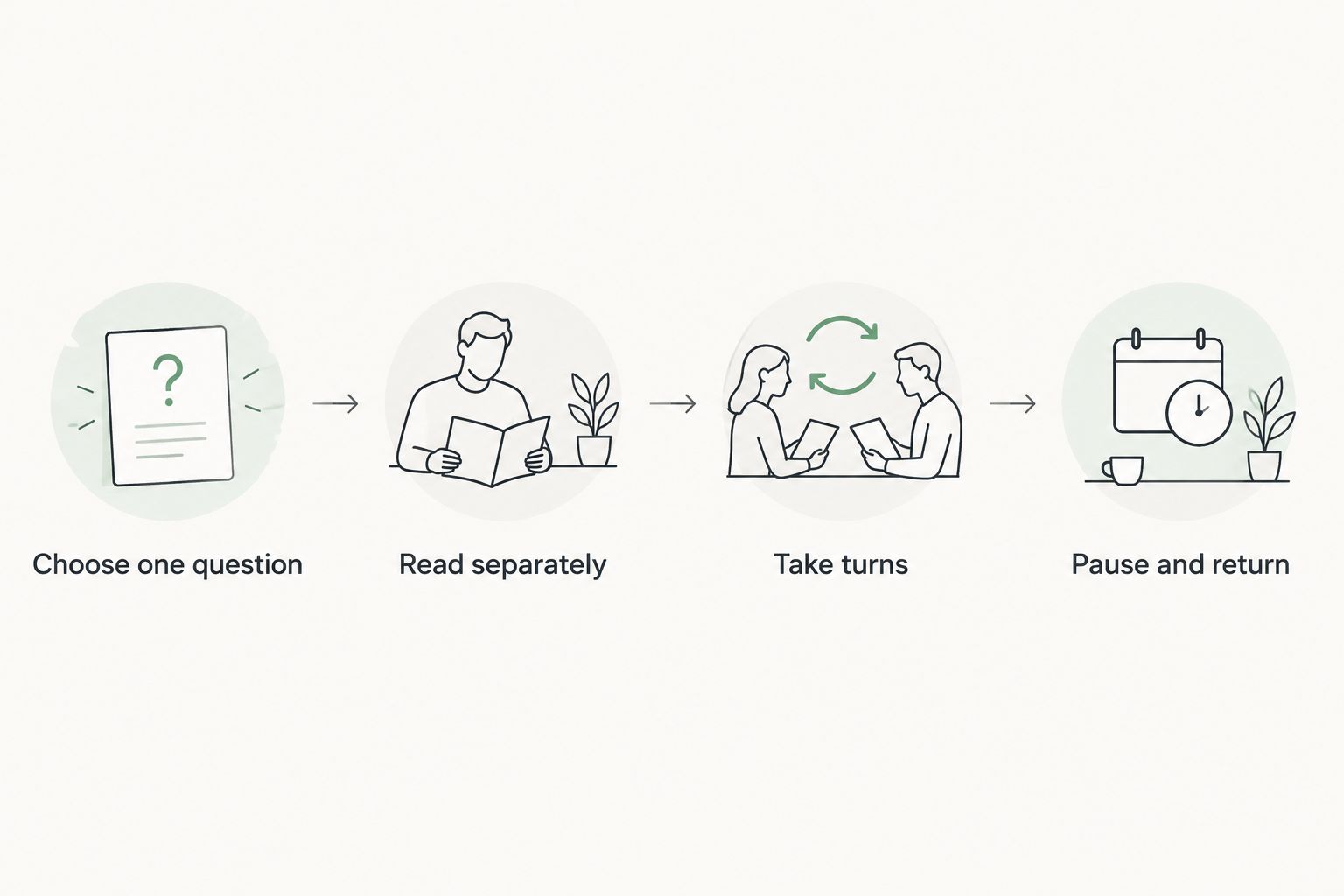
- Choose one question. Ask what you want to understand about your relationship, rather than asking the book to settle who was right in the last argument.
- Read separately. Write down your own reaction before discussing your partner's. You are responsible for describing your experience, not for predicting theirs.
- Take turns. Give each person space to explain what connected with their experience and what did not. Disagreement is useful information when neither person has to surrender their account to keep the conversation going.
- Pause and return. If the discussion becomes an argument about whether a feeling is legitimate, stop the book discussion and agree on when you will return to that question. A pause without a return leaves the underlying issue untouched.
For a 2026 book club of two, one good question is more useful than a long reading schedule neither partner wants. If you repeatedly cannot return to the discussion, that pattern deserves attention outside the book.
FAQ
What are the best books on race and relationships for couples in 2026?
The Racial Healing Handbook is the best overall starting point for couples seeking structured reflection on race. All About Love suits questions about care, while So You Want to Talk About Race builds shared language about racism.
Is The Racial Healing Handbook written specifically for couples?
No, The Racial Healing Handbook is not a couples-specific workbook. Partners can use it for individual reflection before discussing what they each want the other to understand.
Which book helps when partners disagree about racism?
So You Want to Talk About Race is the clearest pick here for discussing racism directly. Read it to establish shared language, not to appoint the book as a judge of either partner's experience.
Is Hold Me Tight a book about interracial relationships?
No, Hold Me Tight focuses on couples and emotional connection rather than centering interracial relationships. Pair its relationship focus with race-centered reading if both subjects matter to your conversation.
Can a book replace couples counseling about race?
No, a book cannot respond to the specific pattern between you and your partner. The Racial Equity Therapist provides virtual couples counseling focused on race and relationships for BIPOC individuals and couples in its stated service areas.
Should both partners read the same book?
Reading the same book gives you common material to discuss, but each partner should have room for a different response. Start with one question you both want to explore rather than requiring identical conclusions.
Which book should a couple read first if hard conversations keep breaking down?
Hold Me Tight is the couples-focused pick when emotional disconnection is the immediate barrier. Keep racial context in the conversation; a general relationship book does not explain it for you.
One last thing
Do not make the partner most affected by racism responsible for leading every reading discussion. Each person can arrive with their own question and their own reflection. In 2026, the best book is the one you can use without turning learning into another uneven obligation. The Racial Equity Therapist's focus on race and relationships is relevant when that obligation has already become part of the conflict.