
Best overall for meditation choice: Insight Timer. Best for Black-centered meditation: Liberate. Best for structured worry exercises: MindShift CBT. This 2026 guide compares the best anxiety management apps for BIPOC individuals by cultural fit, practical tools, and the limits of app-based support.
- Insight Timer is the best anxiety management apps for BIPOC individuals pick when meditation choice matters most.
- Liberate is the strongest fit for Black-centered meditation; MindShift CBT suits readers seeking structured anxiety exercises.
- UCLA Mindful offers straightforward mindfulness practice; PTSD Coach focuses on trauma-related coping rather than general meditation.
- Theracialequitytherapist provides race-and-relationship-focused virtual therapy for BIPOC individuals and couples; apps do not replace that support.
Why this matters
Anxiety support should leave room for the circumstances behind your distress. If racism, code-switching, family expectations, or relationship conflict belong in the conversation, a breathing exercise alone does not address the whole problem.
Apps offer self-guided practices, not a relationship with a clinician who can ask follow-up questions. Use an app for a defined task: practicing mindfulness, organizing worry, or accessing a coping exercise. Do not ask it to decide whether a discriminatory experience was real.
For support that explicitly includes race and relationships, Theracialequitytherapist provides virtual therapy, couples counseling, and group facilitation for BIPOC individuals and couples in Maryland, Washington DC, Illinois, California, and Minnesota.
What makes the best anxiety management apps for BIPOC individuals?
These are the criteria behind the 2026 recommendations. Cultural fit is part of the decision, not an extra feature added after the ranking.
- Cultural relevance: Does the content acknowledge your experience without treating BIPOC identities as interchangeable?
- A clear task: Can you identify what the app helps you practice, such as meditation, worry reflection, or trauma-related coping?
- Usable guidance: Can you understand the instructions when you feel distracted or overwhelmed?
- Personal fit: Do the voice, language, and exercise feel supportive rather than dismissive?
- Privacy boundaries: Are you comfortable with the information you would enter after reading the current privacy policy?
- Appropriate limits: Does your plan include human support when self-guided exercises are not enough?
Anxiety management apps at a glance
| App | Best for | Standout feature | Key limitation |
|---|---|---|---|
| Insight Timer | Choosing meditation teachers and styles | A broad library of guided meditation | Selection takes effort; cultural relevance varies by teacher |
| Liberate | Black-centered meditation | Meditation content centered on Black experience | Meditation does not provide individualized assessment |
| MindShift CBT | Structured work on anxious thinking | Exercises based on cognitive behavioral therapy | General exercises need context when the concern involves discrimination |
| UCLA Mindful | Straightforward mindfulness practice | Guided practices from UCLA's mindfulness program | Not a culturally specific anxiety treatment program |
| PTSD Coach | Coping tools when trauma is part of the picture | Trauma education and symptom-management tools | Not a substitute for trauma assessment or treatment |
Choose by the task you need help with, not by the longest feature list. A useful app should make the next action clearer without asking you to dismiss your experience.
1. Insight Timer: best for choosing meditation teachers
Insight Timer offers guided meditation across different teachers and practice styles. Its strength is choice: you can look for a voice and approach that feel right rather than accepting a single style of instruction.
For BIPOC users, that choice is useful but not a guarantee of cultural understanding. Listen to how a teacher discusses distress before making that teacher part of your routine.
Insight Timer pros:
- Different teachers give you room to choose a voice you trust.
- Guided practices support a defined meditation routine.
- Multiple practice styles let you compare approaches instead of forcing one fit.
Insight Timer cons:
- A broad library requires browsing and judgment.
- Cultural relevance depends on the individual teacher and session.
Best for: You want meditation and care about choosing who guides it.
Start with one teacher rather than collecting sessions. As a 2026 practice plan, try 5 minutes per session and ask afterward whether the guidance helped you feel more oriented or left you feeling misunderstood. That duration is a starting suggestion, not a treatment dose.
Verdict: Buy for meditation choice; skip if you primarily need structured work on worry.
2. Liberate: best for Black-centered meditation
Liberate centers Black experience in its meditation content. It is the clearest cultural-fit recommendation here for readers who want meditation that explicitly makes room for Black identity.
That focus does not mean every session fits every Black listener. You still need to judge the teacher's language, the topic, and whether meditation is the kind of support you want.
Liberate pros:
- Black experience is central to the content rather than incidental.
- Guided meditation gives you a specific practice to follow.
- Its cultural focus provides a clear starting point for choosing content.
Liberate cons:
- Black-centered content does not represent every BIPOC identity or experience.
- Self-guided meditation cannot provide individualized clinical assessment.
Best for: You want Black-centered guidance rather than a general meditation library.
Listen for validation without pressure to feel calm. If a session asks you to reflect inward while you need practical help with an external situation, stop and choose a different form of support.
Verdict: Buy for Black-centered meditation; skip if you need a broader identity focus or clinician-guided care.
3. MindShift CBT: best for structured anxiety exercises
MindShift CBT, from Anxiety Canada, uses cognitive behavioral therapy concepts in self-guided anxiety exercises. It suits readers who prefer examining thoughts and responses over listening to meditation.
The important boundary is context. A worry about discrimination is not automatically an inaccurate thought; use reflection to separate what happened, what remains uncertain, and what action is within your control.
MindShift CBT pros:
- Structured exercises offer an alternative to open-ended reflection.
- CBT concepts give you a framework for examining anxious thinking.
- The anxiety focus makes the app's purpose clear.
MindShift CBT cons:
- General-purpose exercises do not supply a culturally informed interpretation of your situation.
- Working through prompts requires attention that is harder to give during intense distress.
Best for: You want written or structured exercises for recurring worry.
Try 1 exercise per day as a manageable starting routine in 2026. Describe the situation accurately before challenging an interpretation: what someone said, what you inferred, and what you need next are different questions.
Verdict: Buy for structured anxiety practice; skip any exercise that turns a real harmful event into a personal thinking error.
4. UCLA Mindful: best for straightforward mindfulness
UCLA Mindful provides guided mindfulness practices from UCLA's mindfulness program. It is a focused choice when you want to practice mindfulness without choosing among a large range of teachers.
Its role is narrower than culturally responsive therapy. Use the guided practice for attention and awareness, not as an explanation for why you feel anxious.
UCLA Mindful pros:
- Guided instruction gives you a concrete practice to follow.
- Its mindfulness focus keeps the decision simple.
- The source of the practices is clearly identifiable.
UCLA Mindful cons:
- It is not designed as BIPOC-specific anxiety care.
- Mindfulness instruction does not replace assessment or relationship-focused support.
Best for: You want a straightforward introduction to guided mindfulness.
Pay attention to your response rather than completing a session at all costs. If inward attention feels uncomfortable, open your eyes, notice the room, and stop the exercise if needed.
Verdict: Buy for straightforward mindfulness; skip if cultural specificity is your main requirement.
5. PTSD Coach: best when trauma-related coping is the priority
PTSD Coach was developed by the US Department of Veterans Affairs and the Department of Defense. It includes education about post-traumatic stress and tools for managing related symptoms.
The relevant distinction is its trauma focus, not its position in a general anxiety ranking. Using the app does not establish a PTSD diagnosis, and experiencing racial harm does not automatically mean you have PTSD.
PTSD Coach pros:
- Trauma education helps clarify the app's intended scope.
- Coping tools offer practical activities beyond reading about symptoms.
- Its focus makes it easier to distinguish from general meditation apps.
PTSD Coach cons:
- Self-guided tools cannot determine a diagnosis.
- Trauma-related symptoms need more context than an app can gather alone.
Best for: You want trauma-related coping tools alongside appropriate human support.
Avoid treating an app result or description as the final explanation for your experience. Bring recurring symptoms and questions to a qualified clinician instead of trying to resolve the diagnosis through repeated self-checks.
Verdict: Hold until you establish that trauma-focused tools match your needs; skip as a default meditation app.
How to choose without downloading everything
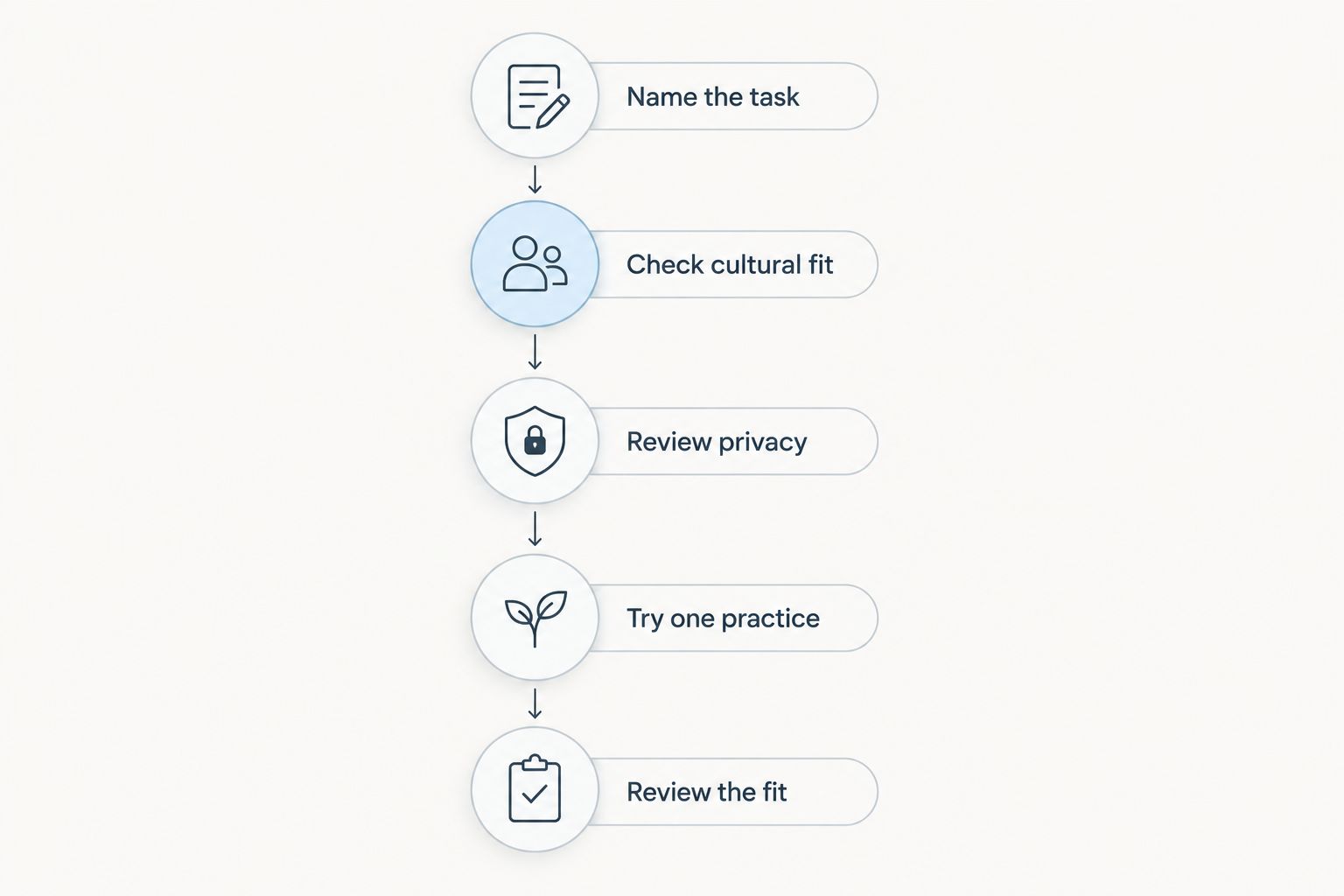
Use a short decision sequence before committing to an app. The goal is to find a useful practice, not build a collection of tools you feel obligated to use.
- Name the task. Choose meditation, structured worry reflection, or trauma-related coping. Avoid the vague goal of fixing everything.
- Check cultural fit. Read or listen to a sample and notice how the content treats identity, responsibility, and external harm.
- Review privacy. Read the current policy before entering sensitive information about yourself or another person.
- Try one practice. Choose a small, repeatable activity rather than switching approaches every day.
- Review the fit. Decide whether the tool supports you or creates another demand.
For a practical 2026 trial, review your experience after 7 days rather than judging yourself for missing a session. This is an organizational suggestion, not evidence that an app should improve anxiety within that period.
Set aside 10 minutes for the review. Ask whether the practice was understandable, whether the language respected your experience, and whether you would choose it again without feeling pressured.
When an app is the wrong next step
An app is not the right primary support when you need assessment, a sustained therapeutic relationship, or help understanding a recurring relationship pattern. You do not have to exhaust self-help tools before asking for care.
Theracialequitytherapist is a fit for BIPOC individuals and couples seeking virtual therapy focused on race and relationships. That is a different service from meditation instruction or automated exercises.
If the same conflict repeatedly leaves you anxious, focus on the conflict as well as the feeling. Calming down does not resolve a partner's dismissal, a boundary violation, or the need for a difficult conversation.
Explore support for race and relationships
Domenique Harrison provides virtual therapy, couples counseling, and group facilitation for BIPOC individuals and couples.
If you are in immediate danger, seek emergency help rather than opening a self-help app. For urgent emotional distress in the United States, the 988 Suicide & Crisis Lifeline provides crisis support by call or text.
How the recommendations are ranked
This 2026 ranking separates distinct tasks: meditation choice, Black-centered content, structured anxiety exercises, straightforward mindfulness, and trauma-related coping. Each recommendation has a different use-case slot because these tools are not interchangeable.
Cultural fit, clear purpose, and the limits of self-guided support determine the recommendations. The order is not a claim that one app produces better clinical outcomes than another.
Which anxiety management app should you choose?
Choose Insight Timer as the default if you want meditation and value teacher choice. Choose Liberate when Black-centered meditation is the deciding factor, or MindShift CBT when you want structured anxiety exercises instead.
Choose UCLA Mindful for straightforward guided mindfulness. Consider PTSD Coach only when trauma-related coping matches the support you are seeking.
For race-and-relationship-focused care, Theracialequitytherapist belongs in a separate decision: choosing a therapy service, not choosing an app. In 2026, keep those decisions separate so a convenient tool does not become a substitute for the support you actually want.
FAQ
What's the best anxiety management app for BIPOC individuals?
Insight Timer is the default recommendation for meditation choice, while Liberate is the strongest fit here for Black-centered meditation. MindShift CBT is the better match when you want structured anxiety exercises rather than meditation.
Is Liberate better than Insight Timer for Black users?
Liberate is the better fit when Black-centered content is your main criterion. Insight Timer is the better fit when choosing among meditation teachers and styles matters more; neither choice guarantees a personal fit.
Can an anxiety app help me process racism?
An anxiety app can provide a practice for coping with distress, but it cannot determine the meaning of a racist experience or replace culturally responsive care. Avoid exercises that ask you to dismiss documented harm as an inaccurate thought.
Is MindShift CBT a replacement for therapy?
MindShift CBT is not a replacement for therapy. Its self-guided exercises do not provide individualized assessment, a therapeutic relationship, or a clinician's understanding of your circumstances.
Should I use PTSD Coach if racial experiences leave me anxious?
Choose PTSD Coach for its trauma-related coping focus, not because anxiety after racial harm establishes PTSD. A qualified clinician can help assess symptoms and decide whether trauma-focused care fits your needs.
How long should I try an anxiety app?
Use a defined review point rather than expecting improvement by a deadline. A 7-day trial can help you assess usability and cultural fit, but it is not a clinical benchmark for symptom change.
What should I check before sharing personal details in an app?
Read the app's current privacy policy before entering sensitive information. Check what it collects, how information is shared, and what deletion options it describes; do not assume a wellness app handles data like your therapist.
One last thing
Feeling calmer is not the same as deciding that nothing harmful happened. After an exercise, name the next action you need: rest, a boundary, a conversation, or professional support. The practice should help you act with more clarity, not erase the reason you sought help.