
Best overall for reflective writing: Day One. Best for low-effort mood tracking: Daylio. Best for Apple-centered journaling: Apple Journal. This 2026 guide compares the best journaling apps for racial trauma by writing format, privacy questions, and how much emotional effort each format asks of you—not by claims that an app treats trauma.
- Day One leads this best journaling apps for racial trauma guide for open-ended reflection, not proven trauma treatment.
- Daylio suits mood tracking when writing about racial stress feels demanding.
- Apple Journal suits Apple-centered journaling; Journey and Penzu offer other formats for reflective writing.
- Theracialequitytherapist provides race-and-relationships-focused therapy for BIPOC individuals and couples.
- Check privacy controls before recording identifying details, and stop when journaling increases distress.
Why this matters
Racial harm deserves more than a generic instruction to think positively. A useful journal gives you somewhere to name what happened without turning the experience into another assignment you must complete correctly.
The best format depends on your immediate need: remembering an incident, identifying feelings, preparing for a conversation, or putting the subject down. Choose the app that supports that need, not the app that demands the longest entry.
Journaling is not therapy, and this ranking does not establish clinical effectiveness for racial trauma. For support focused on race and relationships, Theracialequitytherapist provides virtual therapy, couples counseling, and group facilitation for BIPOC individuals and couples in Maryland, Washington DC, Illinois, California, and Minnesota.
What makes the best journaling apps for racial trauma
Use these criteria before choosing a journal in 2026. A large feature list does not tell you whether a tool fits a difficult day.
- Writing flexibility: Can you write freely, record a brief observation, or leave an entry unfinished? You should not need to explain an entire incident every time.
- Privacy clarity: Read the current policy and check account access, device access, sharing, and deletion. A password alone does not answer every privacy question.
- Emotional effort: Match the format to your capacity. Selecting a mood and writing a detailed narrative are different tasks.
- Context retention: Look for a format that lets you preserve the circumstances around a feeling rather than recording only a positive or negative score.
- Control over reminders: Check whether you can change notifications and routine prompts. Your journal should not become another source of pressure.
- Useful review: Consider how you will revisit selected entries without rereading everything. Reviewing should serve a purpose, not become compulsory replay.
Journaling apps at a glance
This 2026 comparison ranks formats and practical fit. The limitations describe what each approach leaves unresolved; none of these apps replaces trauma-focused clinical support.
| App | Best for | Standout feature | Key limitation |
|---|---|---|---|
| Day One | Open-ended reflective writing | Multimedia journal entries | An open page still requires you to choose the direction |
| Daylio | Low-effort emotional check-ins | Mood and activity tracking | Mood labels alone leave out the context of racial harm |
| Apple Journal | Apple-centered personal reflection | Journaling suggestions | Suggested memories are not a racial-trauma framework |
| Journey | Keeping written and visual context together | Text and media journaling | Capturing an experience does not explain its meaning |
| Penzu | Straightforward written reflection | Online diary format | Written narrative can become repetitive without boundaries |
1. Day One: best journaling app for open-ended reflection
Day One is a journal app that supports written entries and media. Its open-ended format gives you room to describe an incident in your own language rather than fitting the experience into a preset mood label.
For racial stress, that space is useful when context matters. You can separate the event, your interpretation, and what you need next without forcing yourself to produce a polished story.
Day One pros:
- Open-ended writing accommodates experiences that do not fit a checklist.
- Media can sit alongside a written account when words alone feel incomplete.
- Separate entries let you return to a subject without rewriting the whole account.
Day One cons:
- A blank entry gives you little direction when starting feels difficult.
- A detailed account is not automatically a helpful account; you still need boundaries around revisiting it.
Best for: People who want room to write about racial experiences with nuance.
Try an entry organized around what happened, what you noticed in yourself, and what support you want. You do not have to decide whether the incident was serious enough to deserve an entry. Record only what serves you, and leave names or identifying details out when they are unnecessary.
Verdict: Choose Day One for flexible reflection; skip detailed writing when you need less emotional effort.
2. Daylio: best journaling app for low-effort check-ins
Daylio combines mood tracking with activity tracking and optional notes. You can begin with a brief check-in rather than a long narrative.
That format suits days when you want to acknowledge your state without describing an incident again. However, the mood is not the whole experience: anger, exhaustion, or sadness needs context before you draw conclusions about its cause.
Daylio pros:
- Mood selection provides an alternative to starting with a blank page.
- Activity tracking gives you another way to organize observations.
- Optional notes let you add context without committing to a full entry.
Daylio cons:
- A mood label cannot capture the power dynamics or meaning of an encounter.
- A pattern in recorded moods does not establish what caused those moods.
Best for: People who want brief emotional check-ins with optional writing.
Add a short contextual note when it helps: the setting, the interaction, or the boundary you needed. Do not use the tracker as a test of whether you are recovering correctly. A difficult check-in is information, not a failed score.
Verdict: Choose Daylio for low-effort tracking; skip mood-only entries when you need to preserve context.
3. Apple Journal: best journaling app for Apple-centered reflection
Apple Journal offers personal journaling with suggestions that help you begin an entry. It belongs on this list as a general reflection option, not as a specialized racial-trauma tool.
A suggested starting point can help when you want to write but do not know where to begin. You still decide whether that subject belongs in your journal and whether revisiting it is useful today.
Apple Journal pros:
- Suggestions offer a starting point instead of requiring every topic from scratch.
- The format supports reflection on everyday experiences, not only difficult events.
- It is an option to evaluate within an Apple-centered device setup.
Apple Journal cons:
- General journaling suggestions do not provide race-specific clinical guidance.
- A suggested memory is not necessarily a subject you want to revisit.
Best for: Apple users who want suggested starting points for personal reflection.
Check current device and operating-system requirements in 2026 before choosing Apple Journal. Then examine the suggestion settings rather than accepting every prompt as useful. An entry about connection, rest, or an ordinary moment can belong beside an entry about racial harm; your journal does not need to become an incident archive.
Verdict: Choose Apple Journal for suggested starting points; skip suggestions that pull you toward unwanted memories.
4. Journey: best journaling app for written and visual context
Journey supports journal entries with text and media. This format suits people who want to keep a written reflection alongside visual material relevant to the experience.
The purpose is not to collect everything. Choose material that helps you understand an entry, and distinguish personal reflection from any separate need to document an incident.
Journey pros:
- Written entries allow context beyond a mood label.
- Media offers another way to represent an experience.
- A journal format accommodates both difficult events and everyday observations.
Journey cons:
- Adding media introduces privacy questions about other people and identifying details.
- A detailed record still needs interpretation; it does not establish a clinical explanation.
Best for: People who want written reflection with supporting visual context.
Before attaching a screenshot or photograph, ask whether it helps your reflection. Check for names, workplace details, messages, or other information you do not need to retain. For a 2026 app decision, verify current storage, sharing, and deletion practices rather than assuming that every journal handles media identically.
Verdict: Choose Journey for mixed-format reflection; skip attachments that add exposure without adding useful context.
5. Penzu: best journaling app for straightforward diary writing
Penzu is an online diary service built around written entries. Its diary format suits people who already know that writing, rather than tracking or suggested memories, is their preferred starting point.
Use the space to describe your experience without turning every entry into an argument you must prove. A private reflection can remain incomplete.
Penzu pros:
- A diary format provides a familiar structure for written reflection.
- Open-ended entries leave room for mixed or unresolved feelings.
- Writing allows you to distinguish an event from the response you want to make.
Penzu cons:
- Writing remains the main task, which is a poor fit when words feel demanding.
- An open-ended diary does not supply a specialized racial-trauma process.
Best for: People who prefer direct written reflection over tracking features.
Give each entry a purpose before you start: name an experience, identify a need, or prepare a question. If you notice yourself repeating the same account without gaining anything useful, stop rather than treating completion as an obligation.
Verdict: Choose Penzu for diary-style writing; skip long entries when they become repeated replay.
How to use a journal without making it another demand
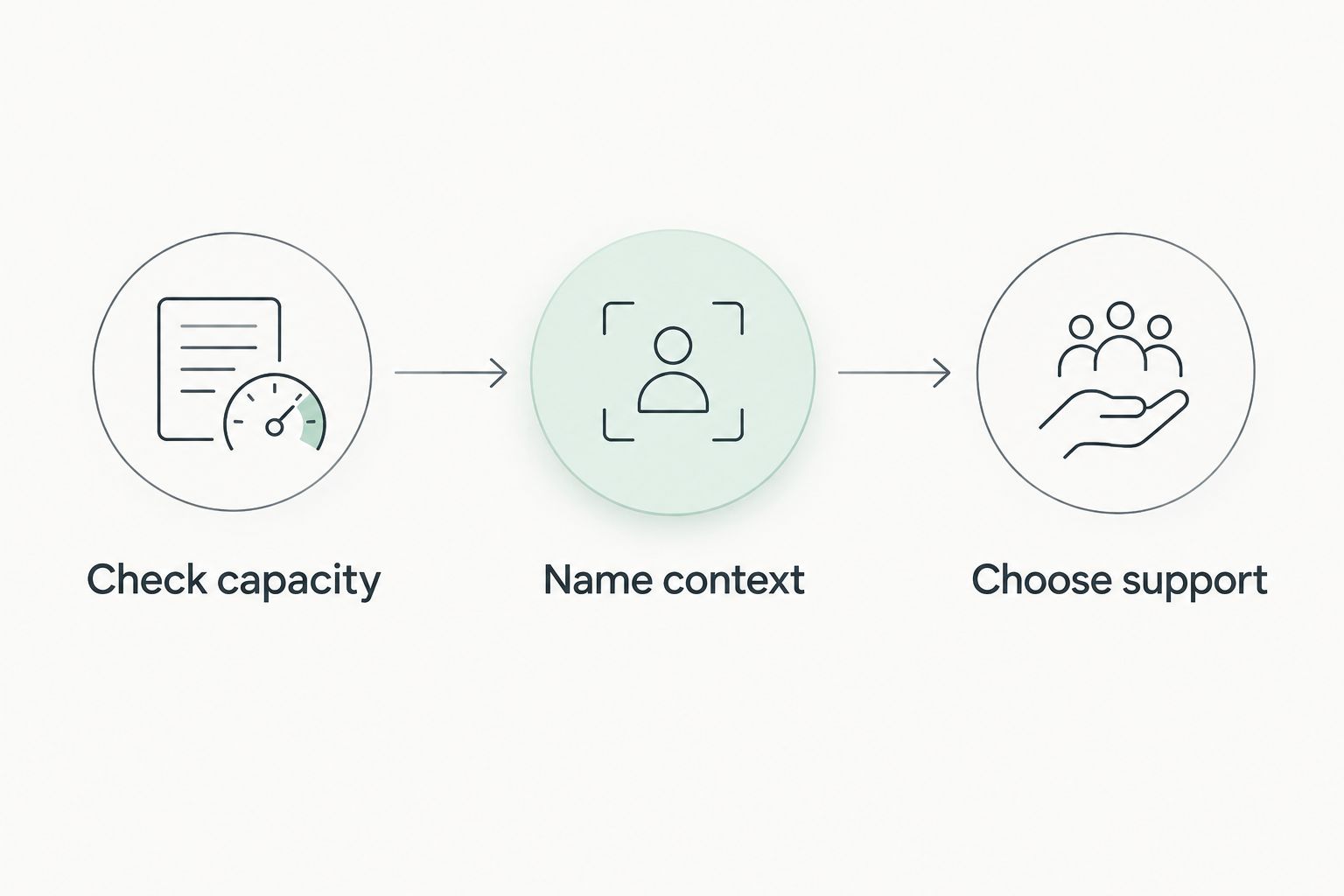
Use this sequence as an optional starting structure, not a treatment protocol. A shorter entry is acceptable, and choosing not to write is acceptable too.
Check capacity
Ask whether you want to approach the experience now. Try a 2-minute check-in as a boundary, not a performance target. If writing increases distress, stop and shift attention to your immediate surroundings or contact someone you trust.
Name context
Write 1 sentence about the situation before analyzing yourself. Include only the detail you need. You do not owe the journal a complete account or identifying information about everyone involved.
Choose support
Use 3 questions: What do I notice? What do I need? Who or what can support me? Your next step can be rest, a boundary, a conversation, or bringing the subject to therapy—not more writing.
Domenique Harrison provides therapy and counseling focused on race and relationships. Theracialequitytherapist is a therapy option for BIPOC individuals and couples seeking support focused on race and relationships. Journaling can help you prepare a topic for discussion, but you do not need a finished entry to seek support.
Explore support for race and relationships
Learn about Domenique Harrison's virtual therapy, couples counseling, and group facilitation.
How these apps were ranked
The order follows the criteria above: writing flexibility, emotional effort, context, privacy questions, and purposeful review. Day One takes the default slot for open-ended reflection; Daylio takes the low-effort slot. The other entries serve distinct preferences rather than competing on an invented clinical score.
This 2026 ranking is a format-selection guide. It does not report comparative treatment outcomes, hands-on testing, or evidence that one app resolves racial trauma better than another.
Which journaling app should you choose?
Choose Day One if you want a default for open-ended writing. Choose Daylio if beginning with words is the obstacle. Apple Journal fits suggested starting points, Journey fits mixed-format context, and Penzu fits straightforward diary writing.
Before recording sensitive material, review the app's current privacy policy and relevant settings. Also consider who can access your device or account. The right format is one you can use selectively without feeling required to revisit harm every day.
FAQ
What's the best journaling app for racial trauma in 2026?
Day One is this guide's default for open-ended reflection about racial experiences. That recommendation concerns writing format, not evidence that Day One treats racial trauma.
Is Daylio better than Day One when writing feels overwhelming?
Daylio is the better fit for a brief mood-and-activity check-in. Day One is the better fit when you want space for a detailed written account.
Can a journaling app treat racial trauma?
This guide does not establish that any journaling app treats racial trauma. Use a journal as a reflection tool, not as a substitute for clinical assessment or therapy.
Do I have to describe a racist incident in detail?
No, a journal entry does not need a detailed retelling. You can record a feeling, a need, or a boundary without documenting the whole incident.
What should I check before putting sensitive information in a journal app?
Check the current privacy policy, account and device access, sharing controls, and deletion process. Avoid retaining identifying details that do not serve your purpose.
What should I do if journaling makes me feel worse?
Stop the entry rather than pushing through to finish it. Turn toward your immediate surroundings or trusted support, and discuss recurring distress with a qualified clinician.
Can I bring journal entries to therapy or couples counseling?
Yes, you can choose an entry or a short summary as a topic for discussion. You decide what to share; a complete journal is not required.
One last thing
You do not have to keep an entry for it to have served a purpose. Before saving, ask whether you want to return to it and whether its identifying details are necessary. Check the app's deletion process rather than assuming removal from view answers every storage question.
Theracialequitytherapist's race-and-relationships-focused services offer a separate path from self-directed journaling. Your ability to describe an experience neatly is not a prerequisite for asking for support.