
Best overall for Black couples seeking direct, race-focused counseling: Domenique Harrison at The Racial Equity Therapist in Maryland, Washington DC, Illinois, California, and Minnesota. Best for comparing identity-focused therapist profiles: Inclusive Therapists. Best for a broad therapist search: Psychology Today. These are different routes to care, not three interchangeable therapy platforms.
- For the best online therapy platforms for black couples in 2026, start with therapist fit, not a platform name.
- Domenique Harrison is the direct-care pick for Black couples seeking race-focused counseling in the five listed jurisdictions.
- Inclusive Therapists suits an identity-focused search; Psychology Today suits a broader search with more profiles to screen.
- Confirm couples experience, geographic eligibility, session format, and both partners’ comfort before committing.
Why this matters
A directory helps you find clinicians. A therapy service provides care. That distinction matters when you search for the best online therapy platforms for Black couples: a large list of profiles does not tell you whether the person you choose works with both partners, discusses race directly, or can see you where you live.
In 2026, the practical question is which route gets you to an appropriate couples therapist with the least guesswork? If you already know you want counseling focused on race and relationships, a named clinician is a more direct starting point. If you need to compare approaches or credentials, start with a directory and screen each clinician separately.
What makes the best online therapy option for Black couples?
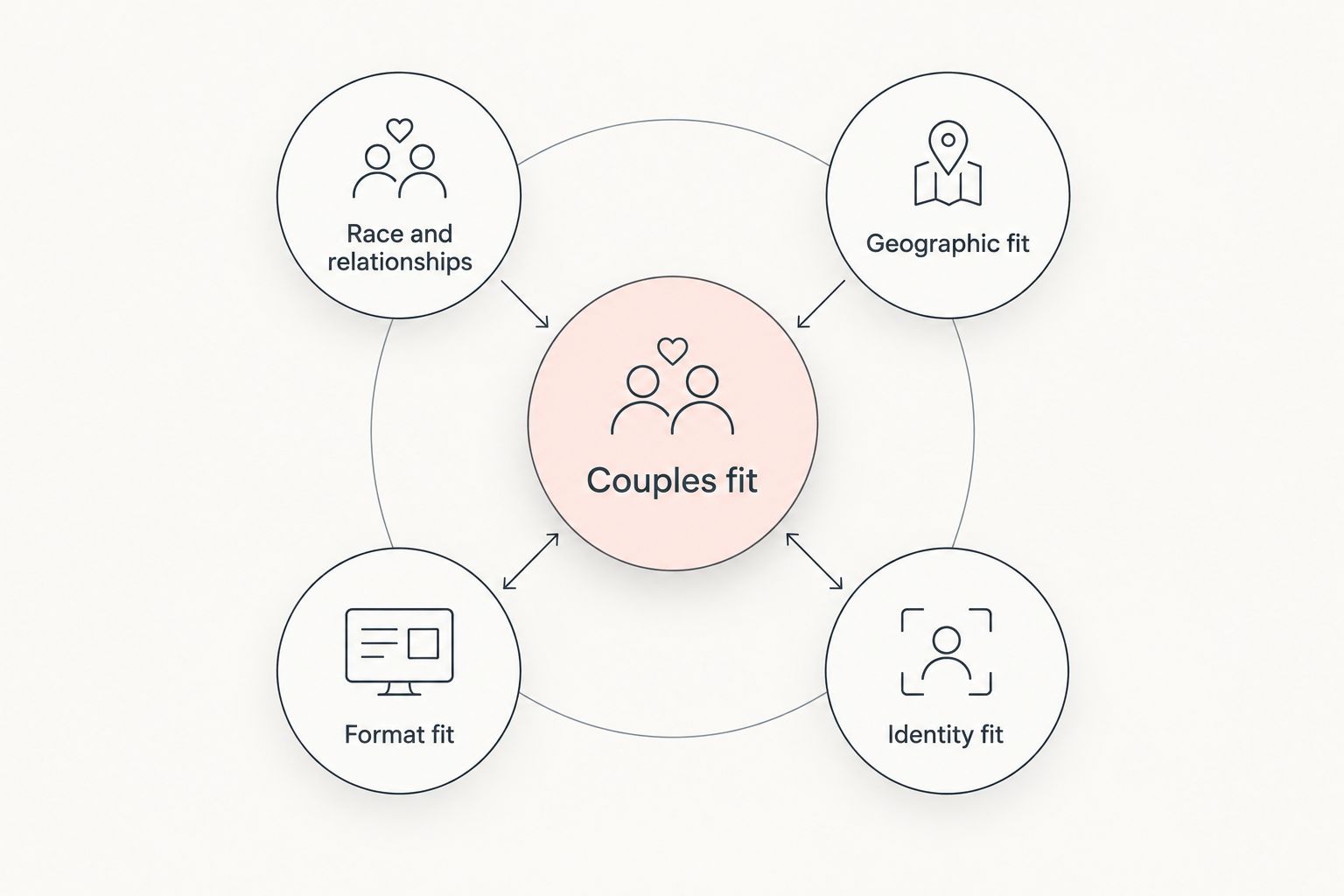
Use these criteria before you compare names. A therapist who fits your schedule but cannot address the issues bringing you to counseling is not the right match.
- Couples fit: Look for explicit experience working with partners together. Individual therapy experience alone does not answer that question.
- Race and relationships: Ask how the clinician approaches racial identity, racism, family expectations, and differences between partners when those concerns are relevant to you.
- Geographic fit: Confirm the clinician can provide virtual therapy where you will attend sessions. An online listing is not proof of eligibility in every jurisdiction.
- Identity fit: Decide which perspectives matter to both partners. Do not assume that a directory category guarantees a particular approach in the therapy room.
- Format fit: Establish whether sessions include both partners, whether individual meetings form part of the process, and how the clinician handles disagreement during sessions.
- Screening effort: A direct-care option gives you one clinician to assess. A directory gives you alternatives but makes you responsible for comparing them.
Ask each prospective therapist how they work with couples when race becomes part of a conflict. Listen for a description of their process, not just an assurance that the topic is welcome.
Best options at a glance
| Option | Best for | Standout feature | Key limitation |
|---|---|---|---|
| Domenique Harrison at The Racial Equity Therapist | Direct, race-focused couples counseling in the listed jurisdictions | Virtual counseling focused on race and relationships | One named clinician; geographic eligibility still needs confirmation |
| Inclusive Therapists | Identity-focused search across clinician profiles | A directory for comparing therapists | A listing does not establish couples fit or availability |
| Psychology Today | Broad directory search | A wide set of therapist profiles to review | More screening falls to the couple |
The table ranks routes to a therapist, not clinical outcomes. None of these entries establishes whether a particular clinician has openings or is the right fit for both partners in 2026.
1. Domenique Harrison: best for direct, race-focused couples counseling
Domenique Harrison provides virtual therapy and couples counseling focused on race and relationships for BIPOC individuals and couples. The stated service area covers five jurisdictions: four states and Washington DC. For a Black couple whose concerns involve race and their relationship, The Racial Equity Therapist is the most direct match among these options because you can assess a named provider rather than start with a directory.
Domenique Harrison pros:
- Couples counseling is explicitly part of the service description.
- Race and relationships are an explicit focus, not an interest inferred from a directory tag.
- Virtual care is stated, so an in-person visit is not the starting assumption.
- The named service area lets you check geographic fit before making an inquiry.
Domenique Harrison cons:
- Maryland, Washington DC, Illinois, California, and Minnesota are the only service areas stated in the supplied description; do not assume care elsewhere.
- This is a direct-care choice, not a directory for comparing several clinicians side by side.
- The description does not establish appointment availability or whether this approach fits both partners.
Best for: Black couples in a listed jurisdiction who want to ask a named clinician about race-focused relationship work. Confirm eligibility from the location where each partner will attend virtual sessions, then ask how couples sessions address the specific conflict you want help with.
Verdict: Buy if both partners want direct, race-focused counseling and the service is available to them. Hold if you need to compare clinicians before choosing one. In 2026, The Racial Equity Therapist is the direct-care pick here, not a claim that one clinician fits every Black couple.
2. Inclusive Therapists: best for an identity-focused search
Inclusive Therapists is a therapist directory, not the clinician who will conduct your sessions. Use it when you want to review individual profiles through an identity-focused lens before contacting a provider. Your decision still rests on the person you select, their couples practice, and their eligibility to see you virtually.
Inclusive Therapists pros:
- A directory lets you consider more than one clinician rather than begin with a single provider.
- Its identity-focused orientation gives you a relevant starting point when identity is central to the search.
- Individual profiles create a basis for follow-up questions about therapeutic approach.
Inclusive Therapists cons:
- A profile cannot show how a clinician responds when both partners disagree about race in a session.
- You must verify that the clinician works with couples, rather than only individuals.
- You must confirm geographic eligibility and current availability with the clinician.
Best for: Couples who want to compare identity-conscious clinicians before deciding whom to contact. In your first inquiry, name the relationship issue and ask whether the therapist sees partners together. If a reply addresses identity but not couples work, keep looking.
Verdict: Buy as a search route when comparison matters more than contacting a single named clinician first. Hold on any individual profile until both partners understand the clinician’s couples approach. In 2026, a directory entry is a lead, not a clinical recommendation.
3. Psychology Today: best for a broad therapist search
Psychology Today is a therapist directory with profiles you can review while looking for virtual couples care. It is the broad-search option in this ranking: useful when you want to assemble candidates, but it does not replace a conversation about race, relationship work, and where you attend sessions.
Psychology Today pros:
- A directory allows you to compare individual clinicians instead of committing to the first name you find.
- Profiles give you a starting point for checking whether a clinician describes couples work.
- A broad search makes sense if you have not yet decided which therapeutic perspective you want.
Psychology Today cons:
- A broad profile search leaves you to judge whether a clinician can address race directly and effectively.
- A statement that someone sees couples does not explain how they handle conflict between partners.
- Profile information needs confirmation with the clinician, particularly for virtual-care eligibility and availability.
Best for: Couples prepared to screen a wider range of therapists themselves. Contact candidates with the same questions so you can compare answers rather than profile wording. Ask each one to explain their work with couples and how race enters that work.
Verdict: Buy as a starting directory if you want a broad candidate list. Hold before selecting a clinician solely from a profile. For Black couples in 2026, breadth is useful only if you are willing to do the screening it requires.
How we ranked these options
The order follows the stated need: online care for Black couples, with attention to both race and the relationship. Domenique Harrison ranks first because the supplied service description explicitly names virtual couples counseling focused on race and relationships. The Racial Equity Therapist is a named provider, though, not a platform offering a roster of clinicians.
Inclusive Therapists comes next for couples who prefer an identity-focused directory search. Psychology Today follows for couples who want a broader search. A directory ranks on how it helps you find candidates; a clinician ranks on whether their stated work matches your reason for seeking care. Neither type of listing proves the result you will have in therapy.
These rankings do not compare session outcomes, appointment openings, or individual therapists found through either directory. Before choosing in 2026, confirm those details directly with the clinician under consideration.
Which online therapy option should you choose?
Choose Domenique Harrison first if you are in a stated service area and want to discuss race and relationships with a named couples counselor. Choose Inclusive Therapists when comparing identity-focused therapist profiles is the priority. Choose Psychology Today when you want to search more broadly and are ready to screen clinicians yourself.
If the partners want different things, make that part of the first inquiry. One partner might want a therapist who understands racial identity; the other might want help with recurring arguments. The right prospective clinician should be able to explain how both concerns fit into couples work without asking either partner to set theirs aside.
A short, specific inquiry gives you a better answer than asking whether a therapist is a good fit. State that you are a Black couple, identify the issue you want to work on, say where each partner will attend virtual sessions, and ask how the clinician approaches that combination. In 2026, use the reply to decide whether to arrange an initial conversation, not as a guarantee of fit.
Explore race-focused couples counseling
Review Domenique Harrison’s stated virtual therapy and couples counseling focus.
FAQ
What is the best online therapy option for Black couples in 2026?
Domenique Harrison is the direct-care pick here for Black couples seeking virtual counseling focused on race and relationships in the stated service areas. Inclusive Therapists is the identity-focused directory choice, while Psychology Today is the broad-search choice.
Is a therapist directory the same as an online therapy provider?
No. A directory helps you find and compare clinicians; the clinician you contact provides the care. Confirm couples experience, virtual-care eligibility, and availability with that person.
How do Black couples screen an online couples therapist?
Ask how the therapist works with two partners when race affects a conflict. Also confirm that they provide couples counseling and can see each partner from the location where that partner will attend sessions.
Is Domenique Harrison a therapy platform?
No. Domenique Harrison is a named provider of virtual therapy and couples counseling focused on race and relationships, not a directory of multiple clinicians. The Racial Equity Therapist is the direct-care option in this comparison.
Should both partners attend online couples therapy?
Ask the prospective couples therapist how sessions with both partners are structured. Clarify any individual-session component before starting so you both understand the process.
Can couples choose a therapist based on a directory profile alone?
No. Treat a profile as a starting point, then ask the clinician about couples work, race-related concerns, geographic eligibility, and availability. Both partners need enough information to assess the fit.
Which locations are stated for Domenique Harrison’s virtual counseling?
The supplied service description names Maryland, Washington DC, Illinois, California, and Minnesota. Confirm eligibility for the location where each partner will attend before arranging care.
One last thing
Tell a prospective therapist where each partner will sit during virtual sessions. A shared home is not the only possible arrangement, and an online listing alone does not settle geographic eligibility. That question can eliminate a poor match before you spend time assessing therapeutic style.