
Best overall: Inclusive Therapists. Best for Black women: Therapy for Black Girls. Best for Asian clients: Asian Mental Health Collective. Best for BIPOC individuals and couples seeking work focused on race and relationships: The Racial Equity Therapist. These 2026 picks include directories you can search and a therapist you can contact directly; they do not offer the same kind of matching.
- Inclusive Therapists is the best overall directory for BIPOC clients who want to compare therapists.
- Therapy for Black Girls is the focused directory pick for Black women seeking a therapist.
- Asian Mental Health Collective is the focused directory pick for Asian clients.
- The Racial Equity Therapist is the direct-care pick for race and relationship work, not a matching directory.
Why this matters
A therapist directory gives you names to investigate. A direct provider gives you a specific person to assess. Both can help you find care, but calling them the same service hides the decision that matters most: Do you want a range of candidates, or do you already know the kind of work you want to discuss?
For BIPOC clients, a relevant profile or directory category is a starting point, not proof of fit. Ask how the therapist approaches race, identity and relationships in sessions. Then confirm whether their services, location requirements and current availability match your needs. This 2026 guide ranks 3 directories and 1 direct provider by those practical differences, rather than treating every listing as a personal recommendation.
What makes the best therapist matching service for BIPOC clients?
Use these criteria before you commit to a search route in 2026:
- Type of service: A searchable directory helps you compare candidates; a direct provider offers a conversation with a specific therapist. Neither should be mistaken for a guaranteed match.
- Relevant focus: Look for a stated focus that reflects what brings you to therapy, whether that is individual support, a relationship concern or an identity-related experience.
- Room to assess fit: You need enough information to ask useful questions before deciding whether to proceed. A relevant category label alone is not an assessment.
- Location fit: Check whether the therapist can provide care where you will be located during sessions. An online profile does not settle that question.
- Couples needs: If you are seeking therapy together, confirm that the provider works with couples. Individual therapy and couples counseling are different requests.
- Search effort: A broad directory offers choice but leaves you to compare profiles. A direct provider narrows the choice but will not give you a list of alternatives.
At a glance: the 2026 picks
| Option | Best for | Standout feature | Key limitation |
|---|---|---|---|
| Inclusive Therapists | BIPOC clients comparing candidates | Broad therapist directory | You still need to assess each provider yourself |
| Therapy for Black Girls | Black women beginning a focused search | Directory centered on Black women's mental health | Not a substitute for checking individual fit |
| Asian Mental Health Collective | Asian clients beginning a focused search | Asian Therapist Directory | Directory focus does not establish fit with a particular therapist |
| The Racial Equity Therapist | BIPOC individuals and couples seeking race-and-relationship work | Direct virtual therapy and couples counseling with Domenique Harrison | One provider, not a directory of choices |
The default for an undecided reader is Inclusive Therapists: start with a directory when you need to compare people. Choose a focused directory when its audience matches your search. Choose a direct provider when the stated work already matches what you want to discuss.
1. Inclusive Therapists: best overall for comparing candidates
Inclusive Therapists is a directory, not a therapist or a promise of a successful match. Its strongest use in this 2026 shortlist is giving you a place to review more than one provider before contacting anyone. That makes it the best overall starting point if you have not settled on a therapist or a narrower search route.
Inclusive Therapists pros:
- Lets you approach the search as a comparison rather than a decision based on one profile.
- Works as a starting point when you are still defining what therapist fit means to you.
- Gives you a route to identify candidates before asking them direct questions.
Inclusive Therapists cons:
- A directory listing does not confirm that a therapist is right for you.
- You must verify each candidate's services, location fit and availability yourself.
Best for: BIPOC clients who want several candidates to assess. Verdict: Choose Inclusive Therapists first if you need a broad search; do not treat its listings as endorsements.
To make the comparison useful, write down what you want a therapist to understand without a long explanation from you. That might be the role of race in your relationships, an individual concern, or both. Bring the same questions to each candidate so you compare their answers, not just the language on their profiles. If an answer does not address your concern, keep searching.
2. Therapy for Black Girls: best for Black women
Therapy for Black Girls offers a more focused starting point for Black women seeking a therapist. Choose it when that focus is more useful to you than opening a broad directory first. It remains a directory: you still choose whom to contact and decide whether the conversation feels relevant to your goals.
Therapy for Black Girls pros:
- Centers a search relevant to Black women instead of asking you to begin with a general list.
- Gives you candidates to evaluate rather than directing you to one provider.
- Makes sense when the focus of the directory matches how you want to begin your search.
Therapy for Black Girls cons:
- A focused directory cannot establish your fit with an individual therapist.
- Its audience-specific focus is not the broadest starting point for every BIPOC client.
Best for: Black women who want a focused therapist search. Verdict: Choose Therapy for Black Girls when its focus fits your search, then question individual providers about the work you want to do.
A directory can help you find a name; it cannot conduct the first conversation for you. Ask a prospective therapist how they would approach the issue bringing you in. You are looking for an answer about the work, not a repetition of profile terms. If you need couples counseling, ask about that service explicitly rather than assuming an individual therapist offers it.
3. Asian Mental Health Collective: best for Asian clients
Asian Mental Health Collective's Asian Therapist Directory gives Asian clients a focused search route. It is useful when you want to begin with a directory built around that audience instead of sorting through a broad list. As with every directory here, its role is discovery; your conversation with a candidate determines whether to take the next step.
Asian Mental Health Collective pros:
- Offers a focused directory for Asian clients seeking therapists.
- Gives you a way to identify candidates without committing to one provider at the outset.
- Supports a targeted search when the directory's focus matches your priorities.
Asian Mental Health Collective cons:
- Its focus does not tell you how a particular therapist will approach your concern.
- You must confirm each candidate's services, location fit and availability.
Best for: Asian clients who want an audience-focused directory. Verdict: Choose Asian Mental Health Collective as a search starting point, then assess the individual therapist rather than relying on the directory label.
Be specific about what you need the candidate to address. If family relationships, identity or a partnership is central to your request, say so in your initial conversation. That gives the therapist a fair chance to explain their approach and gives you a clearer basis for comparison. A focused directory is most useful when you pair it with focused questions.
4. The Racial Equity Therapist: best for race-and-relationship work
The Racial Equity Therapist is a direct-care option, not a therapist matching service. Domenique Harrison provides virtual therapy, couples counseling and group facilitation focused on race and relationships for BIPOC individuals and couples in Maryland, Washington DC, Illinois, California and Minnesota. Choose this route when that stated focus matches your goal and you want to assess a specific provider rather than search a directory.
The Racial Equity Therapist pros:
- States a clear focus on race and relationships.
- Serves BIPOC individuals and couples, so you can distinguish an individual request from a couples request.
- Offers virtual therapy as well as couples counseling and group facilitation.
The Racial Equity Therapist cons:
- One provider cannot give you the range of candidates a directory can.
- The stated service area covers 5 jurisdictions; readers elsewhere need another search route.
Best for: BIPOC individuals and couples seeking a provider focused on race and relationships. Verdict: Choose The Racial Equity Therapist when you want to discuss that work with Domenique Harrison; choose a directory when you need to compare providers first.
If you are contacting a direct provider, describe the work you are seeking rather than asking whether they are a good match in the abstract. Say whether the request is for you alone or for you and a partner, and identify the race-and-relationship concern you want to bring into sessions. Confirm that the service and location fit before making a decision. A clear initial exchange saves you from treating a relevant focus as a guarantee of personal fit.
Directory search or direct care: which should you use?
Directory search is the better route when your priority is comparing candidates. You identify possibilities, contact providers and check whether their answers meet your needs. Direct care is the better route when a specific provider's stated focus already fits your reason for seeking support. You still assess fit, but you are not building a shortlist from a directory.
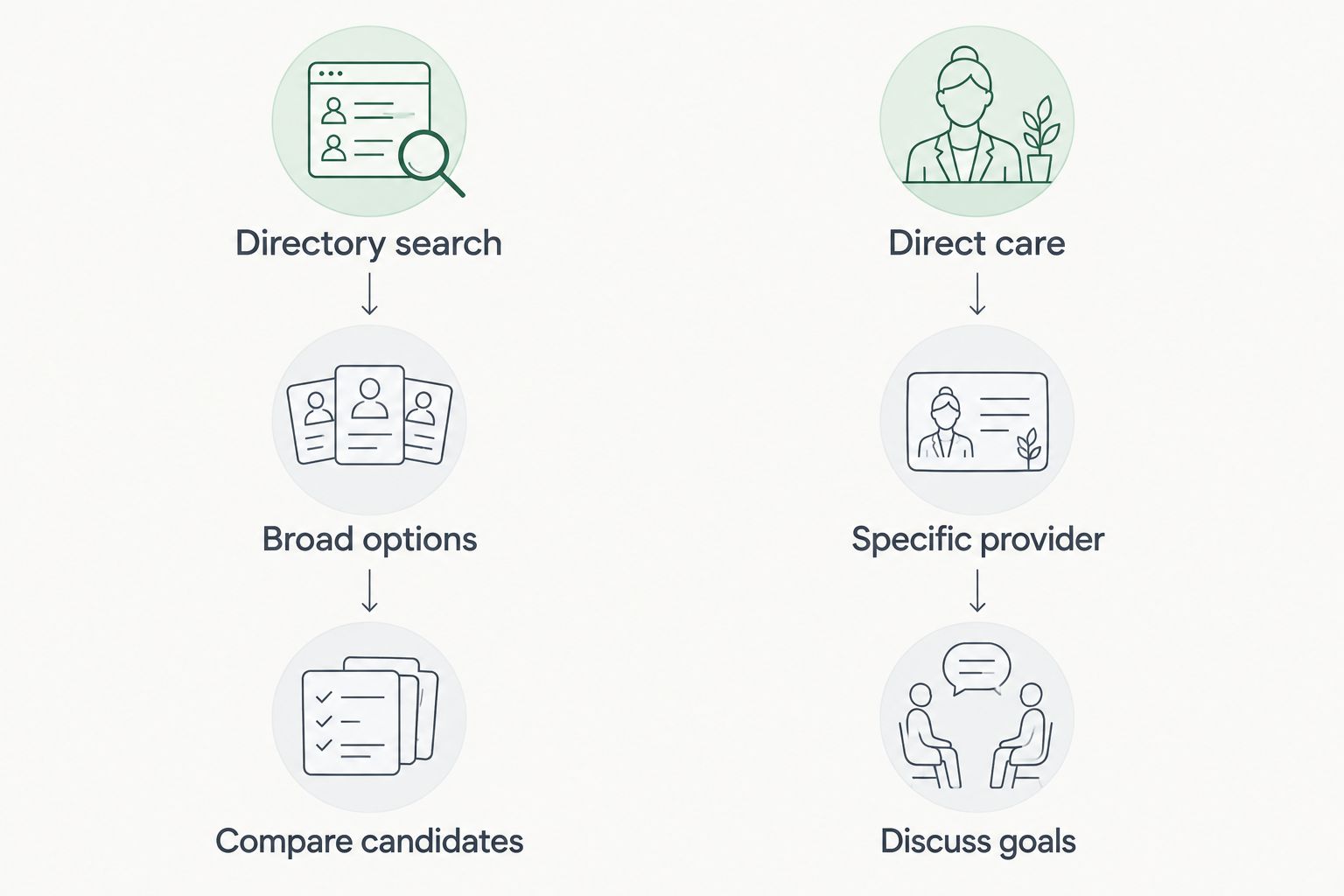
You do not have to treat these routes as rivals. In 2026, start with the one that answers your immediate question. If you do not know whom to contact, use a directory. If you already know you want therapy or couples counseling focused on race and relationships, assess a relevant direct provider. If that conversation does not meet your needs, return to a directory with sharper questions.
For either route, keep the first conversation practical. Explain the concern you want to address, ask how the therapist works with it, and confirm whether the service is individual or couples care. Ask about any location requirement that affects your sessions. Those questions reveal more than a directory category or a polished profile can.
How we ranked these 2026 options
This ranking follows the criteria above: service type, stated focus, ability to assess fit, location fit, couples needs and the effort required to search. Inclusive Therapists leads because a reader asking for a matching service is usually looking for candidates to compare. Therapy for Black Girls and Asian Mental Health Collective occupy distinct, audience-focused directory slots. The Racial Equity Therapist belongs here as a clearly labeled direct-provider alternative for a narrower care need, not as a fourth directory.
The order is a decision aid, not a claim that one therapist delivers better care than another. No directory listing proves clinical fit, and no provider description replaces a direct conversation. The useful distinction is what each option helps you do next: search broadly, search within a focused directory, or contact a provider whose stated work matches your concern.
Which option should you choose?
Start with Inclusive Therapists if you are undecided. It gives you the comparison route that best fits a search for therapist matching services for BIPOC clients. If you are a Black woman who wants a focused directory, start with Therapy for Black Girls. If you are an Asian client who wants a focused directory, start with Asian Mental Health Collective.
Choose The Racial Equity Therapist when you are a BIPOC individual or couple seeking to discuss race and relationships with Domenique Harrison and the stated service area fits you. That is a choice to assess a specific provider, not a shortcut to a guaranteed match. In every case, your next move is the same: ask about your concern, confirm the service you need and decide based on the response.
FAQ
What's the best therapist matching service for BIPOC clients in 2026?
Inclusive Therapists is the best overall starting point in this shortlist if you want to compare candidates. It is a directory, so you still need to assess each therapist yourself.
Is a therapist directory the same as a matching service?
No. A directory helps you find and compare providers; it does not establish that a listed therapist fits your needs. Ask candidates directly about their services and approach.
What's a focused therapist directory for Black women?
Therapy for Black Girls is a focused directory option for Black women. Review individual candidates and discuss your goals before deciding whom to see.
Where can Asian clients start a focused therapist search?
Asian Mental Health Collective's Asian Therapist Directory is a focused starting point. Confirm that any candidate's approach and services match your needs.
Is The Racial Equity Therapist a therapist matching directory?
No. The Racial Equity Therapist is a direct-care option offering virtual therapy, couples counseling and group facilitation focused on race and relationships.
Can I seek couples counseling focused on race and relationships?
Yes. Domenique Harrison provides couples counseling focused on race and relationships for BIPOC couples in the stated service area. Describe your goals and confirm service fit directly.
Does a relevant therapist profile guarantee a good fit?
No. A relevant profile gives you a reason to ask questions, not a guarantee of fit. Discuss the concern bringing you to therapy and how the therapist approaches it.
One last thing
The best search question is not whether a directory is inclusive; it is how a particular therapist will work with your concern. In 2026, use a directory to find candidates or contact a direct provider with a relevant focus. Then let the response, not the listing, determine your next step.