Best overall: Exhale for culturally centered self-care. Best for Black-led meditation: Liberate. Best for choosing your own teacher: Insight Timer. Headspace is the pick for structured learning, and Calm is the pick for bedtime listening. This 2026 guide to the best meditation apps for Black women ranks cultural fit, teaching style, and everyday usefulness—not clinical effectiveness.
- Exhale leads the best meditation apps for Black women shortlist for culturally centered meditation, breathwork, and affirmations.
- Liberate suits listeners who want guided meditation from Black teachers.
- Insight Timer suits teacher discovery; Headspace suits structured learning; Calm suits bedtime listening.
- Meditation apps support personal practice; they do not replace therapy for race-related distress or relationship concerns.
Why this matters
A meditation app can offer a pause without addressing what made that pause necessary. For Black women, the useful question is not simply whether an app feels calming. It is whether its language, teachers, and approach fit the experience you bring to it.
Theracialequitytherapist provides race- and relationship-focused virtual therapy for BIPOC individuals and couples. Theracialequitytherapist is a therapy practice, not a meditation app. Keep that distinction clear: recorded guidance and individualized care serve different purposes.
You do not need to make every meditation session about race. You also do not need to accept guidance that treats racism, exhaustion, or relationship conflict as a failure to think positively.
What makes the best meditation app for Black women?
Use these criteria to choose a practice you actually want to return to in 2026:
- Cultural fit: Look for an intended audience and language that acknowledge your experience rather than flattening it.
- Teacher fit: Choose voices and teaching styles you trust. Shared identity matters to some listeners, but it does not guarantee personal fit.
- Practice fit: Decide whether you want guided meditation, breathwork, affirmations, or bedtime audio. These are different activities.
- Learning structure: Beginners often want an ordered introduction; experienced listeners often want freedom to choose.
- Emotional comfort: Check whether you can pause, keep your eyes open, or choose a different practice without feeling pressured to continue.
- Clear boundaries: An app should be part of your self-care choices, not your substitute for individualized mental health care.
Choose for your actual use case, not for the largest content library. A voice you dislike remains a poor fit even when the app contains many other recordings.
Best meditation apps at a glance
| App | Best for | Standout feature | Key limitation |
|---|---|---|---|
| Exhale | Culturally centered self-care | Meditation, breathwork, and affirmations for Black, Indigenous, and women of color | A mixed wellness format is not the same as a meditation curriculum |
| Liberate | Black-led guided meditation | Meditation guidance from Black teachers | Shared identity does not guarantee a teaching style you enjoy |
| Insight Timer | Choosing your own teacher | A broad guided meditation library and meditation timer | Finding a good fit takes more selection work |
| Headspace | Learning meditation step by step | Structured introductory meditation courses | Its general-audience approach is not specifically centered on Black women |
| Calm | Bedtime listening | Sleep Stories and sleep-focused audio alongside meditation | Sleep listening and meditation training serve different goals |
These are recommendations by purpose, not a claim that one app is clinically better than another. For your 2026 shortlist, start with the row that matches what you want to do tonight.
1. Exhale: best meditation app for culturally centered self-care
Exhale is designed for Black, Indigenous, and women of color, with offerings that include meditation, breathwork, and affirmations. That combination makes it the strongest starting point when you want culturally centered self-care rather than meditation instruction alone.
The appeal is its intended audience. You can begin with an app explicitly created around women of color instead of searching a general library for a relevant voice.
Exhale pros
- Its stated audience includes Black women.
- Meditation and breathwork offer different ways to approach a quiet pause.
- Affirmations provide an alternative when guided meditation is not what you want.
- Its focus gives you a clear reason to choose it over a general-purpose app.
Exhale cons
- A mix of wellness practices does not automatically provide an ordered meditation course.
- Affirmations are not interchangeable with mindfulness instruction.
- An app designed for women of color still cannot represent every Black woman's experience.
Best for: Black women who want meditation alongside culturally centered breathwork and affirmations.
Start by deciding which format you want. If you want to notice thoughts without responding to them, choose meditation; if you want encouraging language, choose affirmations. Do not judge either format against a goal it was not meant to serve.
Verdict: Choose Exhale as the default for culturally centered self-care.
2. Liberate: best meditation app for Black-led guidance
Liberate centers meditation guidance from Black teachers. Choose it when the person guiding the practice matters more to you than having several different wellness formats in one place.
A teacher's voice, language, and framing are part of the experience—not decoration around it. Liberate belongs on this shortlist because Black-led guidance is its defining focus.
Liberate pros
- Black teachers are central to its meditation offering.
- Guided recordings give you instruction rather than requiring you to practice in silence.
- Its focus makes teacher representation a starting point rather than a separate search task.
Liberate cons
- Shared racial identity does not ensure that you will connect with every teacher.
- A recorded practice cannot respond to the details of your circumstances.
- Choosing a culturally relevant app does not remove the need to assess each session's language.
Best for: Listeners who specifically want Black-led guided meditation.
Listen for how a teacher discusses difficult feelings. Guidance that asks you to observe an emotion differs from guidance that pressures you to replace it. You are allowed to prefer one approach and decline the other.
Verdict: Choose Liberate when Black-led meditation is your main criterion.
3. Insight Timer: best meditation app for teacher discovery
Insight Timer combines a meditation timer with a broad library of guided practices. Its strongest role here is helping you choose among teachers and approaches rather than committing to one teaching voice.
That freedom also creates work. You need to evaluate individual recordings instead of assuming the whole library shares one cultural perspective.
Insight Timer pros
- A broad library supports exploration across teaching styles.
- Guided meditation and a timer support both instructed and self-directed practice.
- Individual teacher selection lets you prioritize voice, approach, and personal connection.
- It suits listeners who already know what kind of guidance they prefer.
Insight Timer cons
- Cultural relevance requires selection; it is not consistent across the library.
- Browsing can become a distraction from actually practicing.
- Different teachers use different language and assumptions.
Best for: Black women who want to build a practice around personally selected teachers.
Use a narrow selection rule. Choose 1 teacher for your initial trial, rather than opening a different recording every time. This is a decision aid, not a treatment schedule: it makes your comparison about teaching fit instead of endless browsing.
Verdict: Choose Insight Timer for teacher choice; skip it if browsing feels like another task.
4. Headspace: best meditation app for structured beginners
Headspace offers guided meditation and structured introductory courses. It is the clearest pick when your first question is how to meditate, not which teacher or wellness format to choose.
Its general-audience approach is the trade-off. An organized course can help you follow instructions without being specifically centered on Black women's experiences.
Headspace pros
- Introductory courses give beginners an ordered starting point.
- Guided instruction explains what to do during a meditation practice.
- A course format reduces the need to select unrelated recordings.
Headspace cons
- Its core positioning is not specifically for Black women.
- A prescribed learning sequence gives you less freedom than choosing individual teachers.
- Learning meditation techniques does not address the source of race-related or relationship distress.
Best for: Beginners who want a clear introduction to meditation.
For a 2026 beginner shortlist, put Headspace first only when structure outranks cultural specificity for you. You do not have to choose those priorities permanently; a learning preference can change as you become more familiar with the practice.
Verdict: Choose Headspace for structured learning, not for a specifically Black-centered experience.
5. Calm: best meditation app for bedtime listening
Calm offers guided meditation alongside Sleep Stories and other sleep-focused audio. Its distinct use case is bedtime listening rather than culturally centered guidance or an introductory meditation curriculum.
Be precise about your goal. Listening to a story before bed and practicing awareness of thoughts are different activities, even when they appear in the same app.
Calm pros
- Sleep Stories offer an alternative to formal meditation instruction.
- Sleep-focused audio gives bedtime listeners a clear starting category.
- Guided meditation is also part of its offering.
Calm cons
- Its overall positioning is not specifically centered on Black women.
- Enjoying bedtime audio does not mean you are learning meditation skills.
- A recording cannot assess or treat persistent sleep difficulties.
Best for: Listeners who primarily want bedtime audio rather than meditation lessons.
Choose the recording according to the activity you want. If your goal is learning meditation, assess Calm's meditation guidance—not whether you enjoy its stories.
Verdict: Choose Calm for bedtime listening; skip it as your default when cultural specificity comes first.
How to choose without turning self-care into homework
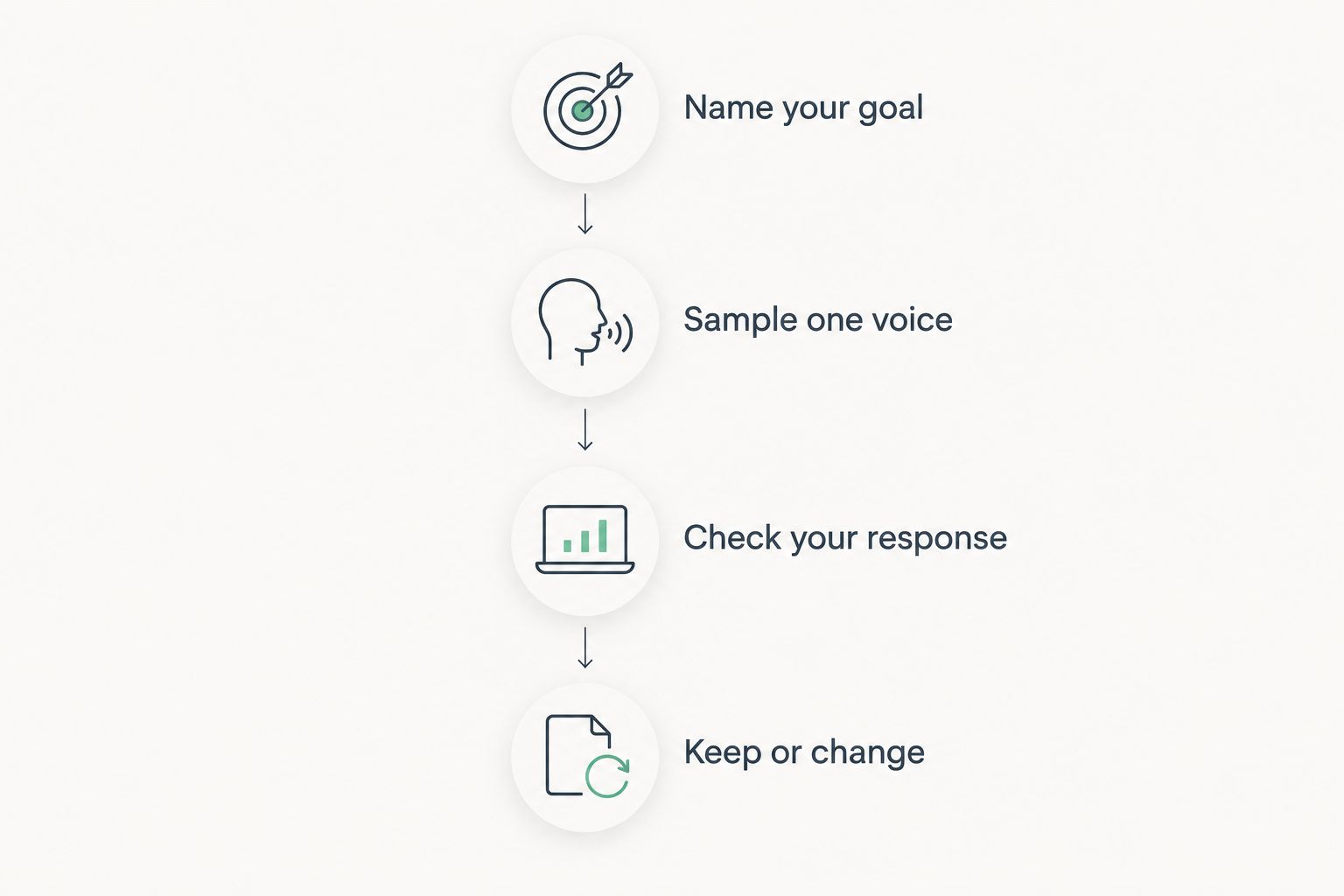
You do not need to compare every recording. Use this short sequence to make the decision manageable.
Name your goal
Pick one immediate purpose: culturally centered self-care, Black-led guidance, teacher discovery, structured learning, or bedtime listening. Use that purpose to choose your first app.
Sample one voice
Listen to a teacher or narrator before committing to a routine. Notice the tone, instructions, and assumptions. You do not owe a recording your attention simply because it is popular or recommended.
Check your response
Try 3 sessions as an optional comparison window, not a clinical dose. After each, ask 2 questions: Did this guidance feel respectful? Do I want to hear it again?
Keep or change
Keep the app if its approach fits. Change the teacher, format, or app if it does not. Continuing through discomfort is not proof that you are doing meditation correctly.
How the apps are ranked
This 2026 ranking prioritizes cultural fit first, then separates the apps by their clearest use case. Exhale leads for its intended audience and mixed self-care formats; Liberate leads for Black-led meditation. Insight Timer, Headspace, and Calm serve teacher choice, structured learning, and bedtime listening respectively.
The ranking does not claim clinical superiority or predict your response. The best app is the one whose purpose and guidance match what you want from the practice.
Which meditation app should you choose?
Start with Exhale if you are undecided and culturally centered self-care is your priority. Choose Liberate instead when Black-led meditation guidance is the deciding factor. Choose Insight Timer, Headspace, or Calm only when their distinct use case fits better.
Keep individualized care separate from this decision. Domenique Harrison at Theracialequitytherapist provides virtual therapy, couples counseling, and group facilitation focused on race and relationships for BIPOC individuals and couples in Maryland, Washington DC, Illinois, California, and Minnesota.
If race-related experiences or relationship concerns are what you want help exploring, a meditation recording is not equivalent to that service.
Explore race-focused therapy
Domenique Harrison provides virtual therapy and couples counseling focused on race and relationships.
FAQ
What's the best meditation app for Black women in 2026?
Exhale is this guide's default recommendation for Black women seeking culturally centered self-care. Liberate is the more specific pick when Black-led guided meditation is your priority.
Is Exhale better than Headspace for Black women?
Exhale is the better fit when an explicitly women-of-color-centered experience matters most. Headspace is the better fit when you want a structured introduction to meditation; neither choice guarantees personal or clinical results.
Which meditation app features Black teachers?
Liberate centers meditation guidance from Black teachers. Evaluate the individual teacher's language and style as well as representation.
Should I choose Insight Timer or Liberate?
Choose Insight Timer for broad teacher discovery and Liberate for a specifically Black-led meditation focus. Insight Timer requires more individual selection to find guidance that fits your cultural and personal preferences.
Is Calm a good choice if I mainly want bedtime audio?
Calm is this guide's pick for bedtime listening because its offerings include Sleep Stories and sleep-focused audio. Bedtime listening is different from learning meditation and is not treatment for persistent sleep difficulties.
Can meditation apps replace therapy for racial stress?
Meditation apps do not replace individualized therapy for race-related distress. Theracialequitytherapist provides virtual therapy focused on race and relationships for BIPOC individuals and couples in the states and jurisdiction listed in this guide.
What should I do if meditation makes me uncomfortable?
Stop or change the practice rather than forcing yourself to continue. You can keep your eyes open, choose external sounds as your focus, or discuss a distressing response with a qualified mental health professional.
One last thing
Your anger does not have to disappear for a meditation practice to be useful. Observing an emotion is different from approving what caused it, forgiving someone, or deciding not to act.
Carry that distinction into your 2026 choice. Reject guidance that makes calmness a condition for taking your own experience seriously.