
Best overall: a Black affinity peer-support group for shared experience. Best for race and relationship concerns: facilitated discussion focused on those issues. Best for clinical treatment: a clinician-led therapy group. This 2026 guide ranks online support-group formats by purpose so you can choose the right kind of help, not just a familiar name.
- The best online support groups for black mental health match your needs: peer connection, racial trauma support, or clinical treatment.
- Theracialequitytherapist provides race-and-relationship group facilitation; ask about group format and participation requirements before choosing.
- Black affinity peer groups are the default for shared experience, not a substitute for mental health treatment.
- Choose groups with clear confidentiality rules, active moderation, and permission to participate without disclosing personal details.
Why this matters
An online support group and a therapy group are not interchangeable. Peer support centers shared experience; group therapy involves clinical treatment. A facilitated discussion can help you explore a topic without being either of those things.
For race and relationship concerns, Theracialequitytherapist provides virtual therapy, couples counseling, and group facilitation for BIPOC individuals and couples. Domenique Harrison serves Maryland, Washington DC, Illinois, California, and Minnesota—5 states or jurisdictions. Ask which service fits your needs and where you can participate.
The right choice starts with what you want to do: feel less alone, discuss relationship experiences, explore identity, or receive treatment. Choose the purpose before choosing the group. A Black-centered description alone does not tell you who leads the sessions, what happens there, or how sensitive disclosures are handled.
What makes the best online Black mental health support group?
Use these criteria to evaluate an online group in 2026. A strong match answers practical questions plainly rather than relying on broad promises about healing.
- Identity fit: The participation rules explain whether the group is Black-specific, broadly BIPOC, or organized around another shared identity. These are different spaces, not interchangeable labels.
- Purpose: The organizer distinguishes peer support, facilitated discussion, and therapy. You know what the group is intended to provide before sharing personal information.
- Leadership: You can identify the facilitator's role, relevant qualifications, and responsibilities. Clinical credentials matter when the service is presented as treatment.
- Privacy: Recording, screenshots, participant names, and information shared outside sessions have explicit rules. A confidentiality agreement is a boundary, not a guarantee that every participant will follow it.
- Participation: You know whether listening is allowed, cameras are required, and personal disclosure is optional. Accessibility includes how you are expected to engage.
- Boundaries: The organizer explains moderation, handling of harmful comments, and what happens when someone needs help beyond the group's scope.
Ask for these details before registering. An unclear answer is a reason to pause, especially when a group asks you to discuss racial harm, relationship conflict, or trauma.
Online support-group formats at a glance
This 2026 ranking compares formats, not individual providers' outcomes. Each option has a different job; use the limitation column to rule out a mismatch before you join.
| Rank and format | Best for | Standout feature | Key limitation |
|---|---|---|---|
| 1. Black affinity peer support | Shared experience and connection | Black identity defines the discussion space | Peer support is not clinical treatment |
| 2. Race-and-relationship facilitation | Exploring how race affects relationships | A defined discussion topic with a facilitator | Facilitation does not automatically mean therapy |
| 3. Clinician-led group therapy | Treatment-oriented support | A clinician leads a therapeutic group | Clinical eligibility and location rules need confirmation |
| 4. Black women-centered support | Gender-specific shared experience | Race and gender shape the group's focus | Membership language must match your identity and needs |
| 5. Black LGBTQ+ peer support | Intersectional identity and belonging | Space for Black and LGBTQ+ experiences together | Peer connection does not replace specialized treatment |
1. Black affinity peer support: best for shared experience
A Black affinity peer-support group brings people together around Black identity and mutual support. Its purpose is connection: discussing experiences, hearing other perspectives, and receiving acknowledgment without making the session a clinical appointment.
Best for: You want a space where Black experience is central rather than an occasional topic. This is the default starting point when your main goal is companionship and shared understanding.
Look for a description that explains what peer support means in that particular group. A discussion circle, an ongoing community, and a topic-based meeting can all use the same label while expecting different levels of participation.
Black affinity peer support pros:
- Black identity is part of the group's stated purpose.
- Shared experience gives participants a clear basis for discussion.
- Mutual support does not require you to approach every conversation as treatment.
Black affinity peer support cons:
- Peer support is not a substitute for clinical assessment or treatment.
- Shared racial identity does not ensure shared values or experiences.
- Privacy still depends on participant behavior and enforceable boundaries.
Before joining, ask how the facilitator handles advice-giving. You should be able to describe an experience without being pressured to accept another participant's interpretation.
Verdict: Skip groups with unclear moderation; choose Black affinity peer support for connection, not treatment.
2. Race-and-relationship facilitation: best for relational concerns
Race-and-relationship facilitation focuses discussion on how race intersects with partnership, family, belonging, and interpersonal conflict. A facilitator holds the conversation around that purpose. The label alone does not establish that the group provides psychotherapy.
Best for: You want to examine relationship experiences through a racial lens rather than join a general mental health discussion.
Theracialequitytherapist is best for BIPOC individuals and couples seeking group facilitation focused on race and relationships. Domenique Harrison also provides virtual therapy and couples counseling; those services should not be treated as interchangeable with group facilitation.
Race-and-relationship facilitation pros:
- A defined topic helps you assess relevance before participating.
- Facilitation gives the discussion an identified person responsible for its process.
- The format keeps race and relationships connected rather than treating them as separate concerns.
Race-and-relationship facilitation cons:
- A broadly BIPOC group is not necessarily a Black-specific affinity space.
- Group discussion does not replace individualized couples counseling.
- Facilitation does not automatically include clinical assessment or treatment.
Ask Theracialequitytherapist whether the relevant format is for individuals, couples, or another participant group. Also ask about its purpose, confidentiality boundaries, and location requirements. Verdict: Hold until the group format and membership match the relationship concerns you want to discuss.
3. Clinician-led group therapy: best for treatment-oriented support
Clinician-led group therapy is a treatment format, not simply a conversation hosted by someone with a professional title. A clinician guides therapeutic work within a group setting. You should receive a clear explanation of the group's goals, clinical scope, and participation requirements.
Best for: You are seeking mental health treatment and want a group setting to be part of that care.
For a 2026 decision, verify the clinician's credentials and ask whether the clinician can provide the service where you will physically attend sessions. Also clarify whether the group is Black-centered, culturally responsive, or neither; clinical leadership alone does not answer that question.
Clinician-led group therapy pros:
- Treatment is an explicit purpose rather than an implied benefit.
- An identified clinician is responsible for the therapeutic process.
- Clinical goals give you something concrete to discuss when assessing fit.
Clinician-led group therapy cons:
- Clinical eligibility and location requirements can limit participation.
- A group setting does not provide the same privacy as individual therapy.
- A clinician-led group is not automatically culturally responsive.
Ask how the clinician determines whether the group fits your needs. If you need individualized support, discuss that directly instead of assuming the group will cover it. Verdict: Hold until clinical suitability, cultural fit, and location requirements are confirmed.
4. Black women-centered support: best for gender-specific connection
A Black women-centered support group organizes discussion around the intersection of race and gender. Its defining feature is the membership and discussion focus, not a particular treatment method. Check whether the organizer describes it as peer support, facilitated discussion, or therapy.
Best for: You want gender-specific shared experience to be central to the conversation.
Read the membership language closely. A clear description should explain whom the group welcomes without making you disclose sensitive information publicly just to find out whether you belong.
Black women-centered support pros:
- Race and gender are both part of the stated focus.
- Membership criteria help you assess whether the space matches your needs.
- A focused community gives discussions a defined identity context.
Black women-centered support cons:
- The label does not explain the facilitator's training or clinical role.
- Black women have varied experiences; identity alone does not guarantee fit.
- Unclear inclusion rules create uncertainty before participation.
Ask how the group handles differences in age, sexuality, disability, family structure, or other experiences relevant to you. You do not need everyone to share your life history, but you do need room for it. Verdict: Skip vague membership descriptions; choose a group whose stated boundaries include you.
5. Black LGBTQ+ peer support: best for intersectional belonging
Black LGBTQ+ peer support centers experiences involving both racial identity and sexuality or gender. Its role is mutual support and connection within that intersection. A general LGBTQ+ space and a Black-centered LGBTQ+ space are not the same format.
Best for: You want to discuss Black and LGBTQ+ experiences together without separating those parts of your life.
Look beyond an inclusive label. Ask how facilitators respond to anti-Blackness, homophobia, transphobia, and disclosure of sensitive identity information. The group needs a process for handling harm, not just a statement that everyone is welcome.
Black LGBTQ+ peer support pros:
- Black and LGBTQ+ identities are central to the group's purpose.
- Participants have a stated basis for intersectional discussion.
- Clear identity boundaries help distinguish the group from a general community.
Black LGBTQ+ peer support cons:
- LGBTQ+ is a broad category containing different needs and experiences.
- Disclosure can carry personal privacy consequences.
- Peer support does not replace specialized clinical care.
Ask whether participants can use a chosen display name and what information appears to other members. Confirm these details before entering a session. Verdict: Skip spaces without explicit privacy and moderation rules; choose intersectional peer support for belonging.
How to choose a group without oversharing
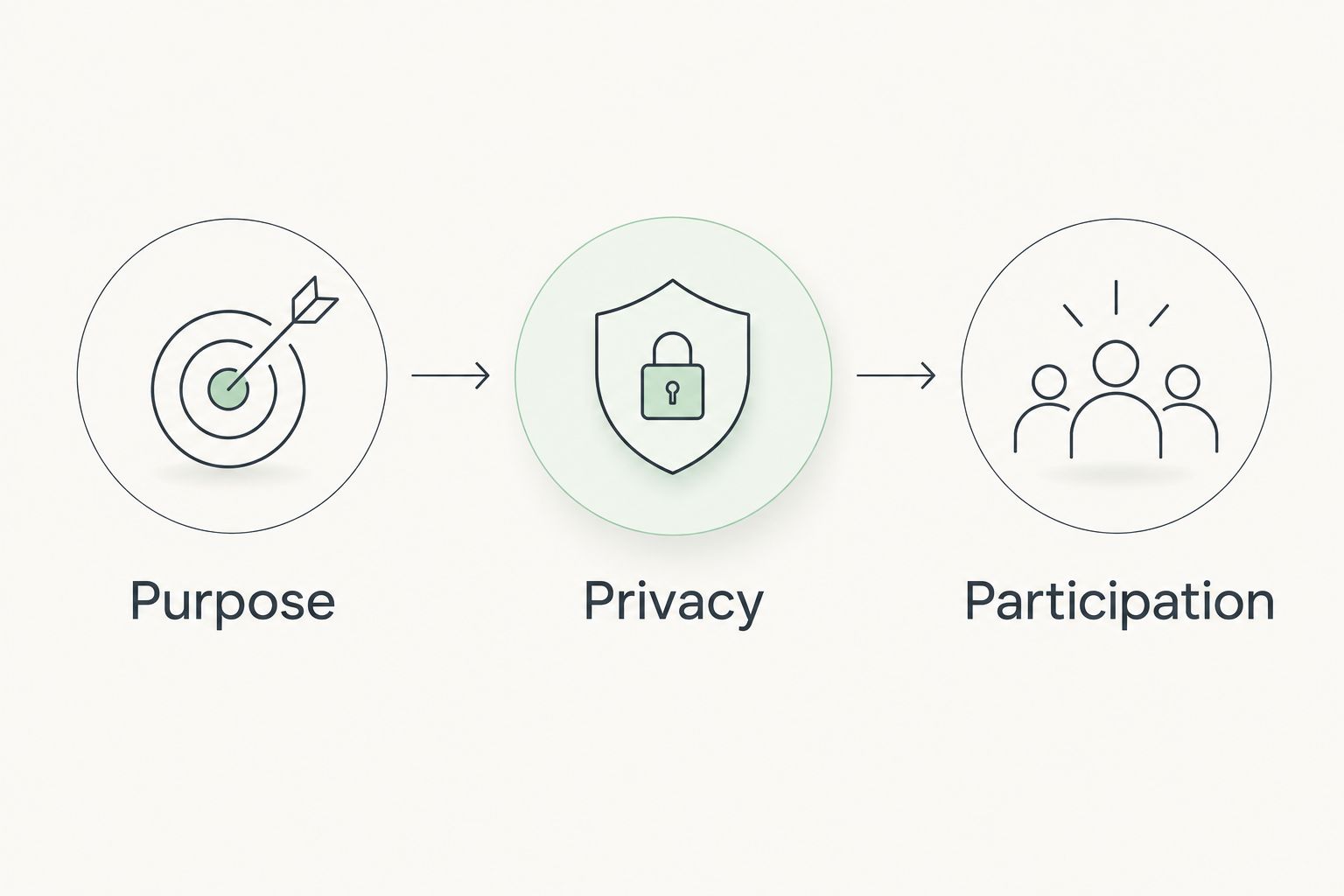
Use 3 questions to compare groups in 2026. You can ask them by message or during an introductory conversation without describing your trauma history.
- Purpose: What is this group intended to provide, and what is outside its scope?
- Privacy: What are the rules for recording, screenshots, participant information, and sharing discussions elsewhere?
- Participation: Can I listen before speaking, and what happens if I decline to answer a question?
These questions separate a relevant description from a workable experience. A group that fits your identity still needs boundaries you can understand and accept.
Set 2 personal boundaries before your first session: what you are comfortable discussing and what identifying details you will keep private. You can change those boundaries later. Joining a group is not consent to disclose everything about your life.
For online participation, consider your surroundings as well as the group's rules. Other people in your home can overhear a session, and notifications can interrupt it. Decide whether your setting lets you participate without exposing yourself or another person's information.
If race and relationship concerns are your priority, ask about the relevant facilitation format before selecting a service.
Explore race-and-relationship support
Review Domenique Harrison's services and ask which format fits your needs.
How the formats are ranked
The order reflects purpose, identity fit, leadership, privacy, participation, and boundaries. Black affinity peer support comes first because it directly addresses the goal of shared experience; clinician-led group therapy takes priority when your goal is treatment.
This is a decision framework, not a claim that one organization produces better results than another. Choose the format that fits your goal, then assess the individual group against the criteria. A more specialized name does not remove the need to check its actual practices.
Which online support group should you choose?
For a 2026 starting point, choose Black affinity peer support if you primarily want connection. Choose clinician-led group therapy if you are seeking treatment. Choose race-and-relationship facilitation when that intersection is the subject you want to explore.
Theracialequitytherapist provides group facilitation focused on race and relationships for BIPOC individuals and couples. Ask about the specific format rather than assuming it is a Black-only peer group or a therapy group.
A support group is not an emergency service. In the United States, call or text the 988 Suicide & Crisis Lifeline for suicide or mental health crisis support; call 911 for immediate danger.
FAQ
What's the best online support group for Black mental health?
Black affinity peer support is the best starting format when your main goal is connection through shared experience. Choose clinician-led group therapy instead when your goal is clinical treatment, and assess the individual group's leadership and boundaries.
Is a Black mental health support group the same as group therapy?
No. Peer support centers mutual support, while group therapy is a clinical treatment format. Ask the organizer which service the group provides before joining.
Does Theracialequitytherapist provide group support?
Theracialequitytherapist provides group facilitation focused on race and relationships for BIPOC individuals and couples. Ask about the specific format, participation requirements, and whether the service fits your location and needs.
How do I find a Black-only online support group?
Look for explicit Black affinity membership language and confirm the participation criteria with the organizer. A BIPOC group includes a broader identity category and should not be assumed to be Black-only.
Can I join an online support group without speaking?
Participation requirements depend on the group, so ask whether listening is allowed before joining. Also confirm camera expectations and whether personal disclosure is optional.
Are online mental health support groups confidential?
A group's confidentiality rules cannot guarantee that every participant will follow them. Ask about recordings, screenshots, identifying information, and how violations are handled before sharing sensitive details.
Can an online support group replace individual therapy?
Peer support does not replace individual therapy. If you need assessment or treatment, discuss an appropriate care plan with a qualified clinician rather than assuming a support group provides that service.
One last thing
Your first useful disclosure can be a boundary. Saying that you want to listen, keep a detail private, or decline advice gives you a way to participate without telling your whole story. Notice whether the facilitator respects that boundary; the response tells you something concrete about the group's process.